Anxiety Attack
Teacher Notes
Related Topics:
Abnormal Psychology, Clinical Psychology, Psychopathology, Lifespan Development
Learning Objective:
People can have different triggers for anxiety. Within an individual, the things that trigger anxiety may be consistent. Recognizing these triggers can better prepare us to regulate our emotions during these uncomfortable times. We can use different strategies to cope through the triggers or to reduce baseline stress to make anxiety more manageable.
Discussion Questions:
- Does your group agree on the numbers (i.e., intensity) of the anxiety triggers? Which anxiety triggers did your group disagree on?
- Student: Our group as a whole mostly agreed on the ratings for the anxiety triggers. We also agreed that a rating 1-7 was too short of a range, and that the ratings were sometimes disproportionate. For example, one trigger was "your house burned down", and while it was ranked the highest (7), it was disproportionate to 6 ratings, for instance "your bike was stolen"
- Teacher: Different things can make different people anxious and at different levels. Certain situations may bring more anxiety if we have had a bad experience with it before. However, some things can universally make people anxious, such as situations that have really straightforward and clear negative outcomes, such as your house burning down. This situation would affect every piece of the person's life. There's urgency and complexity in solving the problem.
-
How does anxiety affect other players in this game?
- Student: You had to strategize around the panic room in order to go back and be uninvolved in the gameplay, which is interesting, as it shows that separating yourself from the game is the best way to play it.
- Teacher: Anxiety can be contagious. Being around others who are anxious could get us thinking in those ways as well and even bring up worries that we did not even consider. This was incorporated into the game, as the first person entering the anxiety spiral could pull others into the anxiety spiral with them.
Evaluations:
Teacher - △ Student - ▲
0
5
Commentary:
This game gets students relating to each other on daily hassles and common struggles (the cards represent relevant stressors). The game is a nice metaphor for anxiety attacks because anxiety attacks are more likely as stressors build and can be "contagious" to other people, who may empathize or want to help the anxious person.
Modifications:
⚪
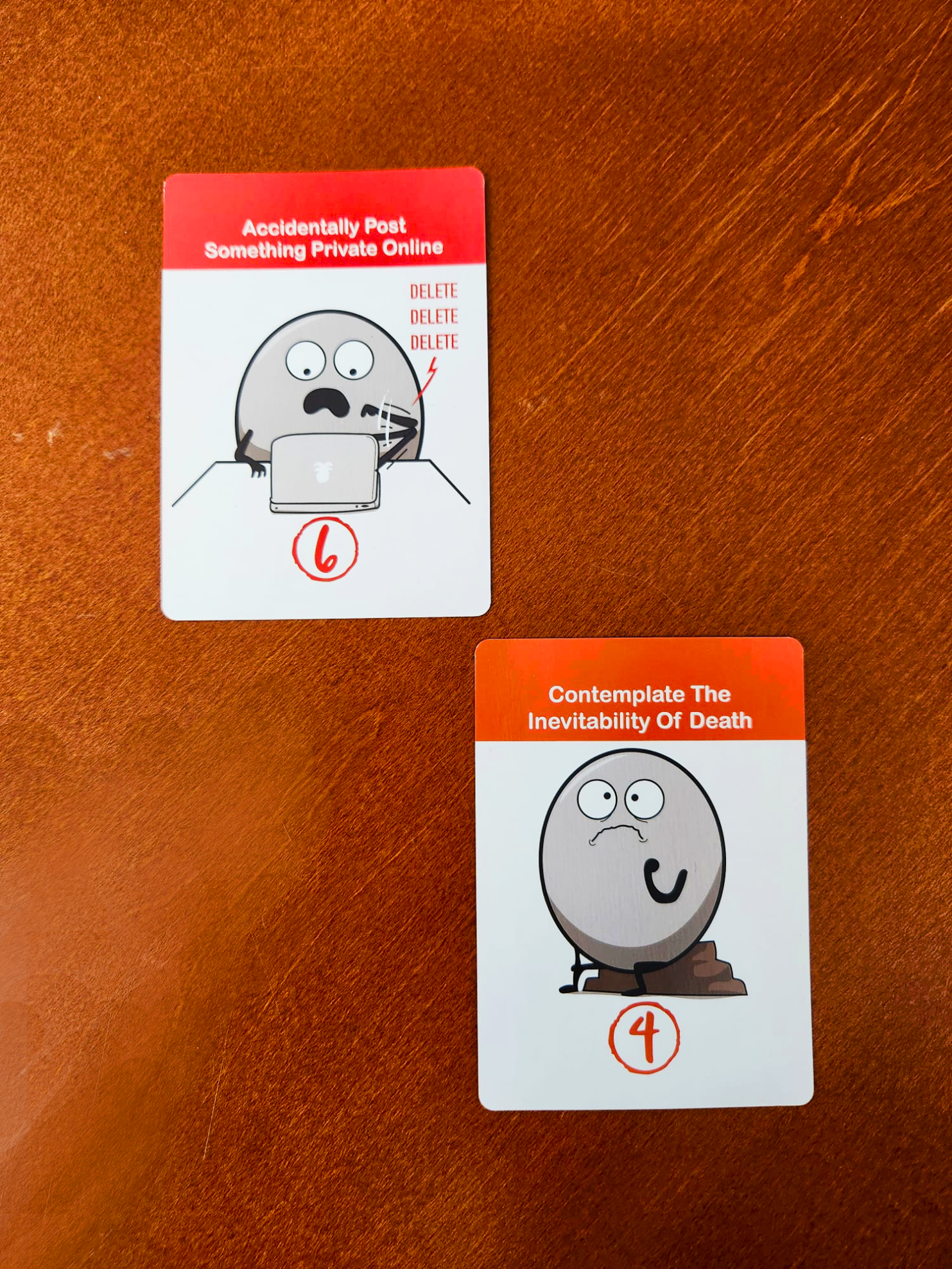
I removed 3 cards for death-related and explicit content
Student Experience
Overall Score: 50% overall effectiveness + 30% engagement score + 20% bonding score
4 / 5
Engagement Score:
Average of the following scores:
Interest, Enjoyment, Motivation, Engagement, Effort
3.97 / 5
Bonding Score:
Average of the following scores:
Welcoming, Interaction,
Connection, Relatedness
3.45 / 5
% Students Who Felt Excluded:
0.2
% Average group size
5.5
Favorite Game: % students who voted
0
number of students who voted
0
More Ratings:
Click Here for breakdown of engagement and bonding scores
Sample size for this game's ratings:
14
Rorschach
Teacher Notes
Related Topics:
Abnormal Psychology, Clinical Psychology, History of Psychology
Learning Objective:
Psychoanalysis is a therapeutic approach that uses glimpses into the subconscious as a way to understand and address an individual's deep rooted desires and fears. Inkblot tests asks clients to freely associate from a visually ambiguous stimulus. The client's first response from these inkblots is thought to tell the therapist about the client's personality, mindset, traumas, etc.
Discussion Questions:
- What type of therapy is the inkblot test based on?
- Student: The inkblot test is based off of psychotherapy. It aims to try and reveal thoughts within the subconscious and determine personality traits.
- Teacher: The inkblot test was born out of psychoanalytic therapy, where the goal was to discover the unconscious causes of behavior. The inkblot test was one way to do free association, where the client would report the first thing that comes to mind when they look at an inkblot. The therapist would then interpret the free associations to gain insights about the client.
-
Based on your experience with the game, how effective do you think inkblots are in inferring about a person?
- Student: I would say that inkblots are fairly effective at making psychological assessments about a person because it could possibly show a person's current mental state, as their emotions likely will affect their perception on what they see. However, it is only an inkblot, and basing someone's personality solely based off of what they see in an abstract image is innacurate.
- Teacher: I think it depended on the inkblot and what my group members said. Some words they freely associated can be associated with positive and negative things, such as a cat is cute and a bat is scary or mysterious, but I do not know whether I can safely assume these associations for the group member. Maybe cats are scary because they are allergic to them. Ultimately, I think using it alone is a little risky.
Evaluations:
Teacher - △ Student - ▲
0
5
Commentary:
This game may be a valuable resource in a counseling theories or psychoanalysis course. Students can experience what it's like to get an ink blot test performed on them and discuss the counseling approach. Outside of this context, the game may be more fun than a valuable learning resource.
Modifications:
⚪
No modifications needed
Student Experience
Overall Score: 50% overall effectiveness + 30% engagement score + 20% bonding score
3.68 / 5
Engagement Score:
Average of the following scores:
Interest, Enjoyment, Motivation, Engagement, Effort
3.35 / 5
Bonding Score:
Average of the following scores:
Welcoming, Interaction,
Connection, Relatedness
3.55 / 5
% Students Who Felt Excluded:
0.06
% Average group size
5
Favorite Game: % students who voted
0
number of students who voted
0
More Ratings:
Click Here for breakdown of engagement and bonding scores
Sample size for this game's ratings:
12
Side Effects
Teacher Notes
Related Topics:
Abnormal Psychology, Clinical Psychology, Psychopathology, Lifespan Development
Learning Objective:
Psychological disorders can be treated through therapy and/or prescribed psychiatric drugs. Depending on the diagnosis, a different therapeutic approach or psychiatric drug may be recommended or more effective. These treatments may have side effects. As a clinician, the pros and cons of different treatment approaches may be considered in treating an individual.
Discussion Questions:
- Which (medications or therapy) did you find most helpful in managing symptoms during the game, and why?
- Student: In general, I found that therapies were the most effective for managing symptoms during the game because certain medications could only target certain disorders, while therapies can be adjusted or combined in order to produce a more effective result tailored to the individual. We were able to manage multiple disorders at once more easily this way.
- Teacher: Therapy could be applied widely to very different diagnoses but the medications were very specific to the disorder. This is maybe different from reality in which SSRIs are commonly used for various disorders. I liked how the cards would show a picture of the pill, the name of it, what it treats and also what are the main side effects. I found this to be very educational.
-
What complications arose? In terms of treatment or episodes? How did you choose to resolve them?
- Student: During the game, we uncovered that we had additional disorders, setting us back from treating both these new disorders as well as the one we originally had. We chose to resolve them by combining multiple types of medications and therapies in ways that would be most effective at treating all disorders at once. While this meant that some disorders took longer to treat, it ultimately ended up being the best way to deal with them simultaneously.
- Teacher: The game became more complicated as we collected more diagnoses. Treating the comorbid disorders became more tricky and sometimes we needed to focus on one over another depending on our resources and our bandwidth. This shines light onto how complicated psychiatry could be.
Evaluations:
Teacher - △ Student - ▲
0
5
Commentary:
This game is pretty straightforward to play. It would be a nice game to use as review for a clinical psychology unit or for a clinical psychology course. The game has cards with mental disorders, psychiatric drugs and therapy types and gives students the opportunity to discuss treatments for the mental disorders.
Modifications:
⚪
No modifications needed
Student Experience
Overall Score: 50% overall effectiveness + 30% engagement score + 20% bonding score
3.69 / 5
Engagement Score:
Average of the following scores:
Interest, Enjoyment, Motivation, Engagement, Effort
3.61 / 5
Bonding Score:
Average of the following scores:
Welcoming, Interaction,
Connection, Relatedness
3.34 / 5
% Students Who Felt Excluded:
0.12
% Average group size
5.18
Favorite Game: % students who voted
0.96
number of students who voted
1
More Ratings:
Click Here for breakdown of engagement and bonding scores
Sample size for this game's ratings:
12
Concept
Teacher Notes
Related Topics:
Cognitive Psychology, Learning, Memory
Learning Objective:
People develop schemas for concepts. These schemas include features of that concept but also related concepts or features.
Discussion Questions:
- Which features were associated with which concepts more often? Give examples.
- Student: Movies often had the video camera associated with them. For the movies like 101 dalmations and top gun, both used the video camera. Instruments were associated with the sheet music, and then the defining characteristic, like the bow of a violin was associated with an arm, and the keys of a piano were associated with an actual key.
- Teacher: I found that being able to give hints that narrowed down the category of the item worked the best. This was easier when the item we are talking about is a movie or a book, and less so when it is a place. I also realized that some "common knowledge" is not so common and depending on popular culture examples excluded some of my classmates.
-
Which concepts had more consistent guessing? Why may this be?
- Student: Movies has more consistent guessing because their communication relied on pop culture allusions and a defined list of subjects. Rather than music, which was confusing, as it could refer to a song, an artist, and instrument, a teqnique etc. The Film Cue meant film.
- Teacher: Concepts that are distinct and universally known were the easiest to give hints on - things that were not dependent on culture, nationality or geographical location.
Evaluations:
Teacher - △ Student - ▲
0
5
Commentary:
This game may look complicated but the students really enjoyed it. They expressed how difficult it is to give clues, even though the game gives structure on how to think of clues. They also noticed how the effectiveness of clues have a lot to do with the teammate's previous experiences.
Modifications:
⚪
No modifications needed
Student Experience
Overall Score: 50% overall effectiveness + 30% engagement score + 20% bonding score
3.74 / 5
Engagement Score:
Average of the following scores:
Interest, Enjoyment, Motivation, Engagement, Effort
4.24 / 5
Bonding Score:
Average of the following scores:
Welcoming, Interaction,
Connection, Relatedness
3.5 / 5
% Students Who Felt Excluded:
0
% Average group size
5.85
Favorite Game: % students who voted
3.85
number of students who voted
4
More Ratings:
Click Here for breakdown of engagement and bonding scores
Sample size for this game's ratings:
28
Fluxx Math
Teacher Notes
Related Topics:
Cognitive Psychology, Thinking
Learning Objective:
Learning builds off of previous events. Learning a new rule may be easier or harder depending on how often the rule applies and what the
Discussion Questions:
- What kinds of learning or conditioning exists in this game? Give examples.
- Student: My partner and I pretty much had to learn on the fly throughout the entire game. We then also had to condition ourselves to constantly check the rules.
- Teacher: I would say operant conditioning is the most prevalent in this game. There are new rules to learn and consequences for not following the rules or not noticing that a rule would apply in my favor. Therefore, I was motivated to learn the rules in order to get to the win condition faster and end the game.
-
What were the qualities of the rules that were easier or harder to learn? Think about the reinforcement schedules and reward vs. punishment.
- Student: The rules that were easy to learn were the ones set at the beginning of the game, it provides a clear goal of what you are supposed to do, even if the path to get there is extremely complicated and reliant on what either player draws.The rules that were hard to learn were the ones actually played on the board, sinceyou have a lot of rules that lead to crazy situations, like drawing 11 cards and playing through your entire hand every turn.
- Teacher: As more and more rules piled on, the game became harder to play. When the rules were complimentary or each other, or had the same prompt, it was easier to manage the multiple rules at once. For those cases, I would realize that something applied in my situation, and apply multiple consequences, instead of needing to check for multiple very different things.
Evaluations:
Teacher - △ Student - ▲
0
5
Commentary:
Out of all of the fluxx games that we played, the students enjoyed this game the most. The cards were more straightforward and predictable than the original Fluxx game. The numbers also made the game's objectives seem more relevant and meaningful.
Modifications:
⚪
No modifications needed
Student Experience
Overall Score: 50% overall effectiveness + 30% engagement score + 20% bonding score
3.46 / 5
Engagement Score:
Average of the following scores:
Interest, Enjoyment, Motivation, Engagement, Effort
3.84 / 5
Bonding Score:
Average of the following scores:
Welcoming, Interaction,
Connection, Relatedness
3.73 / 5
% Students Who Felt Excluded:
0.08
% Average group size
5
Favorite Game: % students who voted
2.88
number of students who voted
3
More Ratings:
Click Here for breakdown of engagement and bonding scores
Sample size for this game's ratings:
9
Guestimation
Teacher Notes
Related Topics:
Cognitive Psychology, Thinking
Learning Objective:
People tend to use prior knowledge or other presented information as anchors for their estimates or educated guesses. Other strategies people use for estimating attributes include availability heuristic and representativeness.
Discussion Questions:
- How often did you use your prior knowledge to make your guesses? How did this turn out for you?
- Student: I used my prior knowledge for every question in some sense, whether it was directly related to the question or thinking of things that I thought could be connected. Overall, my group did pretty well in the game, so it seemed to work out.
- Teacher: Honestly, I do not remember most of the trivia facts needed to answer these questions correctly. However, I did have a sense of a general ballpark for where my estimate should be, even if I know something that is tangentially related. I used this related fact as an anchor for my guess. Sometimes it worked, sometimes it didn't.
-
How often were you influenced by the numbers listed on the cards? How did this turn out for you?
- Student: I was very influenced by numbers like the dates that it was asking about, as the cost of things have changed majorly in the past century. I ended up being pretty far off on a lot of these questions.
- Teacher: I noticed that the numbers on the cards would anchor my guesses. If I saw a year, I would guess a year near it. If I saw a big number, I would think the answer is also a big number.
Evaluations:
Teacher - △ Student - ▲
0
5
Commentary:
There are a lot of cool facts on the game cards. The cards are divided into themes and typically have some sort of number that the players need to guess. This would be a lovely addition to discussions about judgment like anchoring effect and availability heuristics. As a plus, the students get to learn cool trivia facts.
Modifications:
⚪
No modifications needed
Student Experience
Overall Score: 50% overall effectiveness + 30% engagement score + 20% bonding score
3.85 / 5
Engagement Score:
Average of the following scores:
Interest, Enjoyment, Motivation, Engagement, Effort
3.94 / 5
Bonding Score:
Average of the following scores:
Welcoming, Interaction,
Connection, Relatedness
3.53 / 5
% Students Who Felt Excluded:
0
% Average group size
5.31
Favorite Game: % students who voted
0
number of students who voted
0
More Ratings:
Click Here for breakdown of engagement and bonding scores
Sample size for this game's ratings:
16
Jungle Speed
Teacher Notes
Related Topics:
Cognitive Psychology, Sensation & Perception, Thinking
Learning Objective:
Template matching theory may be used to detect two identical symbols. Parallel search may be used if there is only one distinct feature difference but serial search is needed if there are more feature differences. People use a decision criteria (signal detection theory) for determining whether to take action.
Discussion Questions:
- What kinds of mistakes were people making? Why may this be?
- Student: Everyone was reaching to grab the pole thing when the cards were only similar but not the same shape. I think this may be because everyone tried to look at the bigger picture and take the risk in exchange for speed.
- Teacher: Some of the shapes looked very similar or would be extensions of each other. Sometimes I would react to an edge or swiggly because I think it's another shape and I would get punished for this mistake. Afterwards, I may readjust and be less sensitive to stimuli and miss matching pairs. When the card that says everyone flipped cards at once, I got really stressed and frazzled. I was either slow to react or would commit a false positive.
-
How did you manage your “decision criteria” for acting on an impulse? Did you have more false alarm/positives or misses/false negatives?
- Student: At first, try to remember everyone else first card when is my turn. For other's turn, pay attention to their cards. Having more positives and false alarm.
- Teacher: Whether you are too slow to grab the pole or wrongfully grab the pole, you still need to grab all the discarded cards, so one needs to decide what outcome they are more willing to accept. I don't like being slow so I would grab the pole even if I'm not sure, sometimes this works in my favor, other times I have a false positive. I err on the side of grabbing the pole because I rather be punished for misinterpretting a signal than for having too slow of a response time for being cautious and accurate.
Evaluations:
Teacher - △ Student - ▲
0
5
Commentary:
This game is really easy to learn and to play. Students tend to get really loud when playing this game. It's a game of reflexes and reaction time. It's close to a real life stroop test.
Modifications:
⚪
No modifications needed
Student Experience
Overall Score: 50% overall effectiveness + 30% engagement score + 20% bonding score
4.22 / 5
Engagement Score:
Average of the following scores:
Interest, Enjoyment, Motivation, Engagement, Effort
4.41 / 5
Bonding Score:
Average of the following scores:
Welcoming, Interaction,
Connection, Relatedness
3.66 / 5
% Students Who Felt Excluded:
0.03
% Average group size
6.09
Favorite Game: % students who voted
0
number of students who voted
0
More Ratings:
Click Here for breakdown of engagement and bonding scores
Sample size for this game's ratings:
22
Rapid Reflex
Teacher Notes
Related Topics:
Cognitive Psychology, Sensation & Perception, Thinking
Learning Objective:
People learn to associate a stimuli with a response, but as they are learning these associations, they may need to also learn to inhibit other associations as to not trigger those responses.
Discussion Questions:
- What kinds of mistakes were people making? Why may this be?
- Student: I think a lot of people jumped the gun early and got it wrong if it was a two word card like robin egg for example where they would go to the color robin instead of the robin egg color.
- Teacher: The game rewarded fast reflexes so I would make errors when there is ambiguous answers to a particular card. I would go with what I first think of instead of what is more accurate.
-
Was someone more or less risk averse? Did risk aversion play into their strategy?
- Student: I had more false alarms for sure, but I think that it was more intentional than not. If I was so slow that I would have lost already, then I would intentionally go to a different color in hopes that they were just wrong and it actually worked.
- Teacher: Those with risk aversion are more likely to be slow and not get the card fast enough. The game favored those who would make quick decisions, then it was a luck of the draw whether those quick decisions paid off or not.
Evaluations:
Teacher - △ Student - ▲
0
5
Commentary:
The rules of this game are really simple, as it was originally designed for younger kids. Cards have different objects, colors and commands on them. Students would need to learn the associations and not have the learned associations interfere with the new pairings. There is also some similarities to a stroop test. This game is a little less interactive and fun compared to Jungle Speed.
Modifications:
⚪
No modifications needed
Student Experience
Overall Score: 50% overall effectiveness + 30% engagement score + 20% bonding score
4.24 / 5
Engagement Score:
Average of the following scores:
Interest, Enjoyment, Motivation, Engagement, Effort
4.62 / 5
Bonding Score:
Average of the following scores:
Welcoming, Interaction,
Connection, Relatedness
3.96 / 5
% Students Who Felt Excluded:
0.18
% Average group size
6.5
Favorite Game: % students who voted
1.92
number of students who voted
2
More Ratings:
Click Here for breakdown of engagement and bonding scores
Sample size for this game's ratings:
8
Trial by Trolley
Teacher Notes
Related Topics:
Cognitive Psychology, Thinking
Learning Objective:
People can take a deontological or utiliarian point of view when it comes to moral reasoning. With the different identities and scenarios represented on the game's cards, the players will discuss the factors that contribute to moral reasoning.
Discussion Questions:
- What are the features of trolley "victims" that people are more wanting to spare? more willing to sacrifice?
- Student: People are more willing to spare those that were younger of age, as well as those that have heroic accomplishments. For example, one of the "victims" that was saved was a "philosipher who will one day bring peace to the world". On the other hand, those that have done evil deeds and those of older age were more likely to be sacrificed.
- Teacher: People are more willing to spare people who are related to them, who do good deeds, have potential in future endeavors or have some other utility value to society. People were more willing to sacrifice those who would cause trouble to their social network, society, or the environment. I also noticed that people were more willing to spare women and children.
-
Are people using more utiliarianism or deontological explanations when debating which track to spare?
- Student: In our group, more people held a more utilitarian approach when debating their decision. They focused on end outcome when making their decisions. For example, many decisions were made based on how many people would survive in the end.
- Teacher: Most people used the utilitarian approach, unless there is some blatant moral code or social rule that would violate, then they would choose the deontological decision. When it came to utility, I noticed that sometimes people talked about short-term utility and relational utility and other times they would talk about long-term utility (i.e., better for mankind)
Evaluations:
Teacher - △ Student - ▲
0
5
Commentary:
This game is equally a thinking game and a fun game. The objective of the game lends itself for a lot of discussion and debate. My students had a lot of fun with this game, but I would advise the instructor to carefully go through the cards and take out cards that would be offensive or inappropriate for their students given their culture.
Modifications:
⚪

I removed 11 cards for sexually explicit content
Student Experience
Overall Score: 50% overall effectiveness + 30% engagement score + 20% bonding score
4.39 / 5
Engagement Score:
Average of the following scores:
Interest, Enjoyment, Motivation, Engagement, Effort
4.6 / 5
Bonding Score:
Average of the following scores:
Welcoming, Interaction,
Connection, Relatedness
4.08 / 5
% Students Who Felt Excluded:
0
% Average group size
4.71
Favorite Game: % students who voted
0
number of students who voted
0
More Ratings:
Click Here for breakdown of engagement and bonding scores
Sample size for this game's ratings:
7
The Mind
Teacher Notes
Related Topics:
Cognitive Psychology, Thinking
Learning Objective:
People represent numbers of a mental number line. They may use clues or proxies in order to figure out how far away a number is from a previous number.
Discussion Questions:
- How did you determine when it was safe to put down another number card?
- Student: As we went along we developed a system of knowing when we would place. It came naturally at first from just getting a sense of the game. Later on, we talked about the strategy and it helped a lot. If you had a single digit card you placed it right away. If it was within three digits, place it after 1-2 seconds. 4-10 digits place it after about 4-5 second wait. We could also pick up on clues like hesitation and so on.
- Teacher: I used a combination of response time and social cues to decide whether it is safe to put down the next card. I was also thinking about all possible cards that someone could have and how they would behave differently based on those cards. For example, if they put down a card quickly, I know it is because they are confident that no one else has that card. When there is hesitation across many people, it suggested that they had very big numbers or numbers close to each other.
-
Was someone more or less risk averse? Did risk aversion play into their strategy?
- Student: Out of all four players in the game, I would say that I was the most cautious out of everyone, causing many lost rounds due to the fact that I didnt think that my card was the lowest. I believe that this was because I was not familiar with the game and was slightly confused thorughout the first few rounds. The large range of numbers (1-100) and the small group of players caused the rounds to hold a lot of uncertainty and hesitation amongst everyone, but as the game progressed and all of us became accustomed to each other, the skill level we completed rounds at was elevated greatly.
- Teacher: I was definitely the more risk averse person. I waited longer than needed to make a decision about whether to put a card down. I relied on social cues more than my own intuition. Of course, if my card is the next number, I knew for certain no one had the same card and I put down my card immediately, but if there is one a two cards in between, I hesitated and looked around first before putting my card down.
Evaluations:
Teacher - △ Student - ▲
0
5
Commentary:
This game is really simple to learn and get better at. Players guess what numbers people have based on lengths of delays and pauses. It is a bit one-dimensional though. It is a good tool to talk about the mental number line.
Modifications:
⚪
No modifications needed
Student Experience
Overall Score: 50% overall effectiveness + 30% engagement score + 20% bonding score
4.04 / 5
Engagement Score:
Average of the following scores:
Interest, Enjoyment, Motivation, Engagement, Effort
4.33 / 5
Bonding Score:
Average of the following scores:
Welcoming, Interaction,
Connection, Relatedness
3.69 / 5
% Students Who Felt Excluded:
0.07
% Average group size
5.6
Favorite Game: % students who voted
3.85
number of students who voted
4
More Ratings:
Click Here for breakdown of engagement and bonding scores
Sample size for this game's ratings:
10
Wavelength
Teacher Notes
Related Topics:
Cognitive Psychology, Thinking
Learning Objective:
Features of objects can be represented on a continuous scale (e.g., even similarity between items). Objects, concepts or other features fall somewhere on this scale based on prior knowledge and experience.
Discussion Questions:
- How did you think of the clues for the wheel? Were you using any reference points when figuring out the clues?
- Student: We thought of the clues by thinking about common experiences, pop culture, and other things that people would generally know. I tried to think about a broad group people I know and if they would understand the clue. Specifically, many of the clues referenced RPI and RPI student experiences. On two separate occasions, RPI dining hall food was a clue.
- Teacher: I tried to think of clues that are common objects, frequently used words, or prototypical examples of the adjective. I also took into account the background of the other students in my group, making sure not to pick pop culture examples that are too niche or too old in case my international classmates have not heard of them.
-
Were their some features (extreme labels) that had more disagreement in guessing or longer clue finding? Why or why not?
- Student: The middle of the wheel was the hardest to guess. It is easy to think about extremes, but thinking of something moderate is much harder. Also, it was challenging to give clues for the slightly left and slightly right because people tended to guess extremes when we said clues we thought were moderate.
- Teacher: I found it difficult to come up with clues that would be universally understood when the extreme labels were intangible or abstract words. I feel like I needed to come up with concrete words as clues because using adjectives as hints for intangible or abstract words seemed more difficult.
Evaluations:
Teacher - △ Student - ▲
0
5
Commentary:
This game is a nice way to demonstrate that most features are continuous instead of binary. It can also be tricky to play because some of the word pairs are not commonly thought of as continuous, i.e., people tend to talk about the features on both ends of the spectrum.
Modifications:
⚪
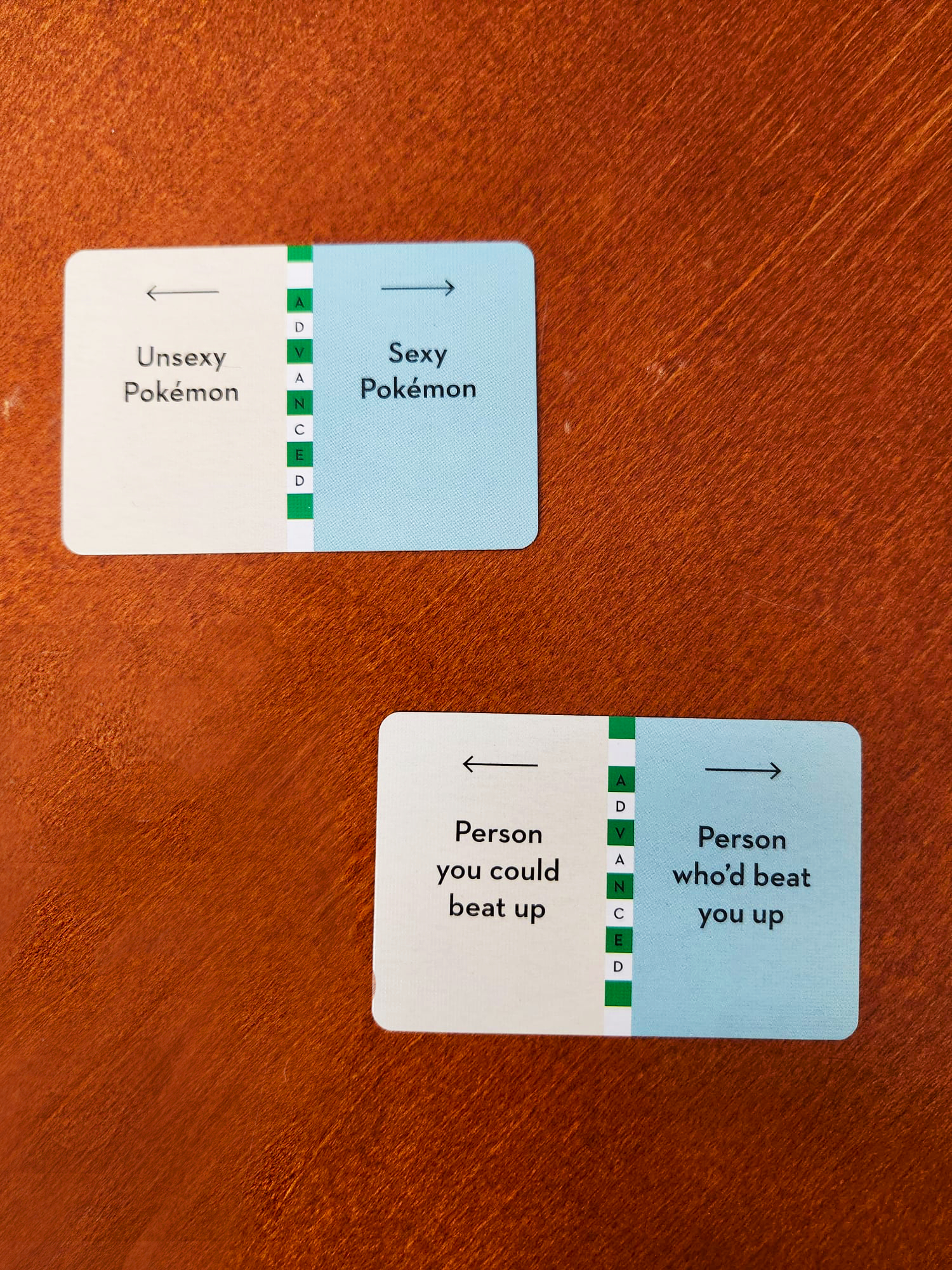
I removed 20 cards that could lead to inappropriate clues
Student Experience
Overall Score: 50% overall effectiveness + 30% engagement score + 20% bonding score
3.67 / 5
Engagement Score:
Average of the following scores:
Interest, Enjoyment, Motivation, Engagement, Effort
4.02 / 5
Bonding Score:
Average of the following scores:
Welcoming, Interaction,
Connection, Relatedness
3.44 / 5
% Students Who Felt Excluded:
0.04
% Average group size
5.5
Favorite Game: % students who voted
3.85
number of students who voted
4
More Ratings:
Click Here for breakdown of engagement and bonding scores
Sample size for this game's ratings:
18
Adulthood
Teacher Notes
Related Topics:
Lifespan Development, Developmental Psychology, Social Psychology, Intimate Relationships
Learning Objective:
Erik Erikson's theory of socio-emotional development identifies eight stages within a person's lifespan, where people have different conflicts that they are trying to resolve within themselves and with society. These conflicts (e.g., intimacy vs. isolation) relate to goals for that life stage (e.g., finding a partner).
Discussion Questions:
- What led you to make the choices you made in the game? What was the main goal (in life) that you were pursuing?
- Student: My choices were based on getting as much happiness, energy, money etc. as possible. Part of this included trying to become an adult as fast as possible. In the game I felt that I would try to get as much of one or two items (e.g. happiness and energy) as possible at the cost of others if I thought it would help me. My main goal was to be as happy as possible as it was one of my goals through the value cards.
- Teacher: At each stage of the game or your character's life, I would focus on something different. There are different challenges and priorities. I tried to maximize happiness and possibilies for the future. I saw how previous choices influenced my next few choices.
-
Did you choose to play a career that is similar to or different from the career choice you would make for your life? Why or why not?
- Student: I would say that the decision made in the game are not the same as I would make in real life. This is because In the game I was trying to prioritize one thing at a time whereas in real life you want a balance. For example there were many turns were I had no money because I was focused on other goals but in real life I would want to have a little bit of everything.
- Teacher: I took a different approach than what I plan to take in real life. It is nice to see another perspective in approaching life's challenges and also helps me consider what I want for my own life and career.
Evaluations:
Teacher - △ Student - ▲
0
5
Commentary:
This game can be a bit complicated to set up and learn how to play, but out of all the lifespan-related games, this one is one of the most thorough, covering topics like education, relationships, jobs, savings, etc. in a more thoughtful way than the Game of Life.
Modifications:
⚪

I removed 1 card for non-monogamous reference
Student Experience
Overall Score: 50% overall effectiveness + 30% engagement score + 20% bonding score
3.56 / 5
Engagement Score:
Average of the following scores:
Interest, Enjoyment, Motivation, Engagement, Effort
3.71 / 5
Bonding Score:
Average of the following scores:
Welcoming, Interaction,
Connection, Relatedness
3.59 / 5
% Students Who Felt Excluded:
0
% Average group size
5.44
Favorite Game: % students who voted
0
number of students who voted
0
More Ratings:
Click Here for breakdown of engagement and bonding scores
Sample size for this game's ratings:
9
Careers (1958)
Teacher Notes
Related Topics:
Career Counseling, Industrial-Organizational Psychology, Lifespan Development, Developmental Psychology
Learning Objective:
Erikson’s psychosocial development theory identifies the issue of identity vs. role as a (internal) conflict that is prominent in adolescence. During this stage, teenagers and young adults may be making decisions about their education status and careers.
Discussion Questions:
- How did your goals affect the careers/jobs you went for?
- Student: My goals propelled me to target specific tiles on the board that would aid me in getting further in my career that I went for. This made it so my career goals were more reachable, and my playstyle was more focused.
- Teacher: The goals that I set made it easier to make decisions within the game. Whenever there was a dilemma that needed to be resolved within the game, I would choose based on what aligned with my goals or values. I would make decisions based on the stage of the game as well, not giving myself too few options for the future
-
Did you choose to play a career that is similar to or different from the career choice you would make for your life? Why or why not?
- Student: The career paths were different to my current career path. It is different from my career path because I believe it is more interesting to play a game about a career I do not know about. \n- I think these questions need refining based on how the game plays.
- Teacher: I took a different approach than what I plan to take in real life. It is nice to see another perspective in approaching life's challenges and also helps me consider what I want for my own life and career.
Evaluations:
Teacher - △ Student - ▲
0
5
Commentary:
This game focuses on choosing a career, getting the education for the game and playing the game as the employee. Given how old this game is, some of the concepts and problems are not as timely anymore, but it does give the students a perspective into how society has changed over the years.
Modifications:
⚪
No modifications needed
Student Experience
Overall Score: 50% overall effectiveness + 30% engagement score + 20% bonding score
3.63 / 5
Engagement Score:
Average of the following scores:
Interest, Enjoyment, Motivation, Engagement, Effort
4.17 / 5
Bonding Score:
Average of the following scores:
Welcoming, Interaction,
Connection, Relatedness
3.77 / 5
% Students Who Felt Excluded:
0
% Average group size
5.73
Favorite Game: % students who voted
0.96
number of students who voted
1
More Ratings:
Click Here for breakdown of engagement and bonding scores
Sample size for this game's ratings:
11
Careers (2003)
Teacher Notes
Related Topics:
Career Counseling, Industrial-Organizational Psychology, Lifespan Development, Developmental Psychology
Learning Objective:
Erikson’s psychosocial development theory identifies the issue of identity vs. role as a (internal) conflict that is prominent in adolescence. During this stage, teenagers and young adults may be making decisions about their education status and careers.
Discussion Questions:
- What led you to decide on the career path in this game?
- Student: Game Mechanics: Certain careers can earn more rewards\nExploration: Explore careers that you might not consider in real life.\nLife Experiences: Real life experiences or desires that have influenced my decision making in the game.
- Teacher: Money and life circumstances right before the age I would go to college influenced my decision to go down certain career pathways. Some career pathways just did not seem practical given the resources that I had during the game and the goals I wanted to achieve. This helps me develop empathy for people with different life circumstances and how they arrived at their occupations.
-
Did you choose to play a career that is similar to or different from the career choice you would make for your life? Why or why not?
- Student: I made a different choice because I got teaching as a career and though it has interested me from time to time, I don't think I would pursue it as a career.
- Teacher: I took a different approach than what I plan to take in real life. It is nice to see another perspective in approaching life's challenges and also helps me consider what I want for my own life and career.
Evaluations:
Teacher - △ Student - ▲
0
5
Commentary:
This game is a newer edition of the Careers (1958). The jobs are more timely but the salaries are still strange. The 1958 version has better scaffolding and supporting accessories. This one has easier instructions and an overall easier play experience.
Modifications:
⚪
No modifications needed
Student Experience
Overall Score: 50% overall effectiveness + 30% engagement score + 20% bonding score
3.24 / 5
Engagement Score:
Average of the following scores:
Interest, Enjoyment, Motivation, Engagement, Effort
3.4 / 5
Bonding Score:
Average of the following scores:
Welcoming, Interaction,
Connection, Relatedness
3.37 / 5
% Students Who Felt Excluded:
0
% Average group size
4.63
Favorite Game: % students who voted
0
number of students who voted
0
More Ratings:
Click Here for breakdown of engagement and bonding scores
Sample size for this game's ratings:
11
CV
Teacher Notes
Related Topics:
Career Counseling, Industrial-Organizational Psychology, Lifespan Development, Developmental Psychology
Learning Objective:
Erikson’s psychosocial development theory identifies the issue of identity vs. role as a (internal) conflict that is prominent in adolescence. During this stage, teenagers and young adults may be making decisions about their education status and careers.
Discussion Questions:
- What kinds of stages or experiences in the game are similar to your own life?
- Student: Being an intern was similar to my life, in the sense that I have interned before, and the same struggles were present in the game as there were in my real life. I also saw some of the cards like tech skills training and inventors workshop which matched some of my academic goals and career goals.
- Teacher: Selecting extracurriculars in K-12 and a major in college, interviewing for internships and eventually getting a job all relate to different cards in the game. The game helps me see the big picture better and consider other career pathways that I may not have considered on my own.
-
Are there any alternative realities that you tried to explore? Something you wouldn’t have done in real life?
- Student: I tried to explore the adventurer lifestyle, I tried the backpacker and around the world travel cards. It let me live a more carefree, and go with the flow kind of lifestyle that isn't very similar to my own.
- Teacher: Because this is a game, I felt more liberated to try out some less "sensible" career pathways that rely a lot more on luck or talent. Given that there is randomness built into the game, it felt less bad or realistic when I failed which makes considering nontraditional choices easier
Evaluations:
Teacher - △ Student - ▲
0
5
Commentary:
This game was probably one of the more confusing career related games to play. There are some advanced game mechanics in the game that can take the students some time to learn and get used to.
Modifications:
⚪
No modifications needed
Student Experience
Overall Score: 50% overall effectiveness + 30% engagement score + 20% bonding score
3.33 / 5
Engagement Score:
Average of the following scores:
Interest, Enjoyment, Motivation, Engagement, Effort
3.64 / 5
Bonding Score:
Average of the following scores:
Welcoming, Interaction,
Connection, Relatedness
3.83 / 5
% Students Who Felt Excluded:
0
% Average group size
5.5
Favorite Game: % students who voted
1.92
number of students who voted
2
More Ratings:
Click Here for breakdown of engagement and bonding scores
Sample size for this game's ratings:
10
The Game of Life
Teacher Notes
Related Topics:
Career Counseling, Industrial-Organizational Psychology, Lifespan Development, Developmental Psychology
Learning Objective:
Erik Erikson's theory of psychosocial development identifies eight stages within a person's lifespan, where people have different conflicts that they are trying to resolve within themselves and with society. These conflicts (e.g., intimacy vs. isolation) relate to goals for that life stage (e.g., finding a partner).
Discussion Questions:
- What led you to make the choices you made in the game? What was the main goal (in life) that you were pursuing?
- Student: In the game I was looking to make as much money before retirement. so as a result I was choosing the paths that led to the most paydays immediatley starting the game. career path vs college, not investing since i was set financially and didnt need to risk investing to make more money.
- Teacher: This game rewarded having wealth, as it cushioned against "bad luck" where money is owed or due to external sources from unexpected circumstanes, allowed one the most opportunities (such as being able to choose between housing options), and retire the soonest. Therefore, I made choices that allowed me to progress through the game advantageously, which often meant choosing options that made the most money or cost the least money. However, my main goal in life is to be happy and build a community, and research at least shows some relationship between money and happiness up until a certain point, in which more money did not make someone more happy. So my goal in life is to make enough money so that I can maximize my happiness but not stress myself out too much making more money after that.
-
Were the decisions you made in the game the same ones you would have made for your own life? Why or why not?
- Student: I would most likely make the same decisions in my real life as well. I do not plan to have kids and want to make enough money in life to retire early. Although this game is not very accurate to real life since it only gives you the bare options that do not extend to what will truly happen in your life.
- Teacher: I would say no, because in real life, I am not centering every decision on money and how quickly I can get to retirement and with the most assets. I believe this aspect of the game oversimplifies life and how to live a happy life.
Evaluations:
Teacher - △ Student - ▲
0
5
Commentary:
This game is a classic and my students were very excited to play it. This version is different from the original game. The careers have been updated and some of the life events have been updated to be more timely as well. The value in the classroom is as much as the students put into it. I suggest giving more direction in discussion topics throughout playing the game.
Modifications:
⚪
No modifications needed
Student Experience
Overall Score: 50% overall effectiveness + 30% engagement score + 20% bonding score
3.93 / 5
Engagement Score:
Average of the following scores:
Interest, Enjoyment, Motivation, Engagement, Effort
4.456 / 5
Bonding Score:
Average of the following scores:
Welcoming, Interaction,
Connection, Relatedness
3.77 / 5
% Students Who Felt Excluded:
0
% Average group size
6.28
Favorite Game: % students who voted
2.88
number of students who voted
3
More Ratings:
Click Here for breakdown of engagement and bonding scores
Sample size for this game's ratings:
11
The Pursuit of Happiness
Teacher Notes
Related Topics:
Lifespan Development, Developmental Psychology, Social Psychology, Health Psychology, Intimate Relationships
Learning Objective:
Erik Erikson's theory of psychosocial development identifies eight stages within a person's lifespan, where people have different conflicts that they are trying to resolve within themselves and with society. These conflicts (e.g., intimacy vs. isolation) relate to goals for that life stage (e.g., finding a partner).
Discussion Questions:
- What kind of life do you think would bring you happiness? Was that the same approach you had with the game?
- Student: I think that the life that would bring me the most happiness is one where I have time to pursue my hobbies and interests and have fun with friends and family, and one where I am well off enough to do so. I tried to do the same thing in the game but the manner in which I did it resulted in more stress building up.
- Teacher: Erikson's stages of psychosocial development highlights goals/conflicts that need to be resolved to reach a state of content/fulfillment. The game has us face some of the decisions and conflicts that come up during Erikson's stages. Making choices about our education, careers and relationships contribute to forming an identity, healthy intimacy and generativity (contribution to society). Therefore, a life that would make me happy in this game and in real life is one that balances these aspects.
-
What were the stages of development you played through? Did you meet the goals of that life stage?
- Student: The stages of development we played through were those until the 3rd Adulthood stage. For the most part, we did meet the life goals of that stage. The game was a little hard to grasp so we played a spinoff version, but we tried our best to stick to the goals of the cards.
- Teacher: The stages of Erikson's psychosocial theory of development that we played through depended on the time we had and how fast players progressed depending on luck and choices. While the game theoretically spans all stages, up until retirement (integrity vs. despair), most of our players were only able to get to choosing/building a career and building a relationship (and getting married).
Evaluations:
Teacher - △ Student - ▲
0
5
Commentary:
This game has a similar feel as the Adulthood game, but a little bit more complicated. There are different sections of the board that the students need to track. Overall, the game takes longer to set up but there are more practical dilemmas that the students face. This game could have value as long as the instructor can provide some support in learning the game.
Modifications:
⚪
No modifications needed
Student Experience
Overall Score: 50% overall effectiveness + 30% engagement score + 20% bonding score
3.38 / 5
Engagement Score:
Average of the following scores:
Interest, Enjoyment, Motivation, Engagement, Effort
3.678 / 5
Bonding Score:
Average of the following scores:
Welcoming, Interaction,
Connection, Relatedness
3.654 / 5
% Students Who Felt Excluded:
0.06
% Average group size
5.25
Favorite Game: % students who voted
0
number of students who voted
0
More Ratings:
Click Here for breakdown of engagement and bonding scores
Sample size for this game's ratings:
12
The Game of Life Goals
Teacher Notes
Related Topics:
Lifespan Development, Developmental Psychology,
Learning Objective:
Erik Erikson's theory of psychosocial development identifies eight stages within a person's lifespan, where people have different conflicts that they are trying to resolve within themselves and with society. These conflicts (e.g., intimacy vs. isolation) relate to goals for that life stage (e.g., finding a partner).
Discussion Questions:
- What led you to make the choices you made in the game? What was the main goal (in life) that you were pursuing?
- Student: What led me to play the way I played was the fact that you have to play for points. I was focused on getting the points and was able to strategize what order to place the cards down on. Points were gained by matching cards of the same symbol so when I knew that, it was easy to plan what to do. The main goal of mine that I was pursuing what under romance/family however I ended up achieving the housing and education goal first.
- Teacher: Unlike the original Game of Life, this game decentered money. Instead there were life goals that you were aiming to achieve and through those achievements you gain points. In order to achieve the life goal, one needs to collect the right cards. Some examples of the cards are going on vacation, checking off something on a bucketlist, getting married, adopting a pet, etc. While the original game did have some of these life events, it happened more seredipitiously and required more luck than there is in planning. The other difference is that you can choose which goals you wanted to aim for. Because of this, I aimed for goals that I actually cared about, such as those that are related to becoming more cultured, such as traveling, learning a new language, etc.
-
Were the decisions you made in the game the same ones you would have made for your own life? Why or why not?
- Student: I think some of the decisions I made in game is the same as what I would do in reality. These were getting a degree and a job as well as getting a house to my own name. I would pursue family like my initial goal given in the game however that is not my first priority
- Teacher: I would say so, because there was more autonomy for choosing how the game would progress for you as a player, there is more agency. Also, there is a greater variety of cards and choices which made me feel empowered to craft the life that I want.
Evaluations:
Teacher - △ Student - ▲
0
5
Commentary:
This game was inspired by the Game of Life, but instead of having a board, the game is based on cards. The game has less focus on stages of life and more focus on the meaning of life and life goals (as the name of the game suggests).
Modifications:
⚪
No modifications needed
Student Experience
Overall Score: 50% overall effectiveness + 30% engagement score + 20% bonding score
3.56 / 5
Engagement Score:
Average of the following scores:
Interest, Enjoyment, Motivation, Engagement, Effort
3.69 / 5
Bonding Score:
Average of the following scores:
Welcoming, Interaction,
Connection, Relatedness
3.49 / 5
% Students Who Felt Excluded:
0.12
% Average group size
5
Favorite Game: % students who voted
1.92
number of students who voted
2
More Ratings:
Click Here for breakdown of engagement and bonding scores
Sample size for this game's ratings:
12
The Game of Real Life
Teacher Notes
Related Topics:
Lifespan Development, Developmental Psychology, Clinical Psychology, Abnormal Psychology, Counseling Skills
Learning Objective:
Erik Erikson's theory of psychosocial development identifies eight stages within a person's lifespan, where people have different conflicts that they are trying to resolve within themselves and with society. These conflicts (e.g., intimacy vs. isolation) relate to goals for that life stage (e.g., finding a partner).
Discussion Questions:
- What challenges do you anticipate in each stage of life? Is this in line with the conflict for this stage of life (according to Erikson’s stages)?
- Student: I anticipated more of an investment in a child then a payout from them as money was collected for every child at the end of the game. However, in reality, providing food, shelter, and healthcare for a child is a large invesment.\n- In addition, the money earned from selling a house was very pertinent to today when house prices have hiked and young people are paying more for houses than retierees have spent.\n<br>
- Teacher: I would say most of these conflicts are within the identity and intimacy stage of development according to Erikson. This makes sense since these cards are designed to apply dialectical behavioral therapy. There were a lot of attribution error, cognitive distortions (that affects self esteem (identity) and maybe prosperity (generativity), and interpersonal problems. The skills that are part of interpersonal effectiveness are the most useful for interpersonal problems. The other problems could be resolved using various CBT techniques.
-
How did you solve the conflicts in the game? Have you had previous experience with these conflicts?
- Student: I have not had issues with many conflicts as I am very young, however, the college investment is a decision I have made to ensure my future career is one that both provides for me, and I am passionate about. Additionally, my family has had to pay for many extra expenses similar to those from the action cards, for example damaging someone's car, maintence in our homes, taxes for community services, etc. These are frustrating, but a part of life and a part of budgeting money.
- Teacher: Based on the cards that I had which depicted dialectical behavioral therapy techniques, I chose the one that seemed the most relevant and effective for the situation. When the people involved are close and on the same level, I am more likely to propose using an interpersonal effectiveness technique. When the problem that arose could not be solved by talking to someone, I would practice techniques that are closer to radical acceptance, emotional regulation, distress tolerance, etc.
Evaluations:
Teacher - △ Student - ▲
0
5
Commentary:
This game is very versatile and can be played in a wide range of contexts. Originally designed to be a dialectical behavioral therapy tool, the game doesn't feel like an educational game. Every group of students that played this game thoroughly enjoyed it. Lots of laugther too. The students found the situations on the cards amusing and challenging (in a good way) to solve using the DBT skills.
Modifications:
⚪
No modifications needed
Student Experience
Overall Score: 50% overall effectiveness + 30% engagement score + 20% bonding score
4.08 / 5
Engagement Score:
Average of the following scores:
Interest, Enjoyment, Motivation, Engagement, Effort
4.03 / 5
Bonding Score:
Average of the following scores:
Welcoming, Interaction,
Connection, Relatedness
3.62 / 5
% Students Who Felt Excluded:
0.02
% Average group size
5.44
Favorite Game: % students who voted
2.88
number of students who voted
3
More Ratings:
Click Here for breakdown of engagement and bonding scores
Sample size for this game's ratings:
32
Amygdala
Teacher Notes
Related Topics:
Behavioral Neuroscience, Biopsychology
Learning Objective:
The amygdala is part of the brain’s limbic system and is responsible for processing emotional stimuli and detecting threats. The amygdala and hippocampus communicate with each other for storing emotionally charged memories.
Discussion Questions:
- What emotional regulation strategies were used?
- Student: The emotion is more likely confusion feeling because the game didn't finish. But I guess the emotional regulation strategies may be cognitive reframing and mindfulness and acceptance.
- Teacher: The game involved a lot of complicated game mechanics and it was very frustrating to learn to play. I ended up needed to use box breathing and getting support and encouragement from my classmates in order to continue to read the rule booklet and trying to figure out the rules.
-
What emotions were easier to balance? What emotions had the biggest impact in the game? Do these align with real life?
- Student: In the game, emotions like Calm or Contentment might be easier to maintain since they are typically associated with stability. In real life, contentment is easier to maintain but slower to accumulate.
- Teacher: There are some good analogies between the game pieces and real life, such as calm and contentment are easier to play with and also easier to feel and manage in everyday life.
Evaluations:
Teacher - △ Student - ▲
0
5
Commentary:
The game has amazing art and mechanics that are a great metaphor for the brain. However, besides aesthetics, there is very little connection to brain function or emotional (dys)regulation. The game is unfortunately difficult to set up and also mentally taxing to play. I would not recommend playing this game as it is, but instead figure out a modification that adds more educational support.
Modifications:
⚪
No modifications needed
Student Experience
Overall Score: 50% overall effectiveness + 30% engagement score + 20% bonding score
2.36 / 5
Engagement Score:
Average of the following scores:
Interest, Enjoyment, Motivation, Engagement, Effort
3 / 5
Bonding Score:
Average of the following scores:
Welcoming, Interaction,
Connection, Relatedness
3.93 / 5
% Students Who Felt Excluded:
0
% Average group size
3.5
Favorite Game: % students who voted
0
number of students who voted
0
More Ratings:
Click Here for breakdown of engagement and bonding scores
Sample size for this game's ratings:
2
Block Happy
Teacher Notes
Related Topics:
Lifespan Development, Developmental Psychology, Psychological Wellbeing, Emotions
Learning Objective:
Emotions can serve as guiding principles for our thoughts and behaviors. Some emotions will motivate us to act in situations or make certain decisions. Some of these actions could have consequences that either serve us or work against our goals and desires. It is important to distinguish when acting on an emotion is productive (e.g., setting boundaries) and when they are counterproductive and thus require emotional regulation.
Discussion Questions:
- How did you gather as much happiness as possible? Which negative emotions were making it more difficult to reach this goal?
- Student: I gathered as much happiness as possible by stealing them from others by using the angry cards. The negative emotions that were making the game more difficult to reach the goal of obtaining a total of seven happiness cards were the angry (allowed you to steal happiness), smug (block angry attack), cheeky (see other player's hand), and bored (choose to miss a player's turn).
- Teacher: Positive emotions and anger (an emotion that gets triggered when something is unfair or needs are not met, motivating us to advocate for ourselves) were the emotions that helped gain happiness points. Other emotions, such as bored, were not as helpful for gaining happiness points either directly or indirectly.
-
How did you balance regulating your own emotions and others?
- Student: I balanced regulating my emotions and others by dropping unnecessary emotion cards to pick up new cards that would benefit my progress of the game. If someone would play a card that would allow them to steal happiness cards from me, I would respond by doing the same back.
- Teacher: In order to create balance of emotions, one needed to play a variety of cards, not only the innocent positive ones, but also the negative ones. For example, to keep a balance of emotions across players, anger (attack) could be responded to by smug (block an attack).
Evaluations:
Teacher - △ Student - ▲
0
5
Commentary:
This game has really cute artwork and really straightforward rules. In practice, the game seemed less fun to plan than the artwork and simplicity suggests. Some students found the game too repetitive and too long to finish. This game could be played in short sessions.
Modifications:
⚪
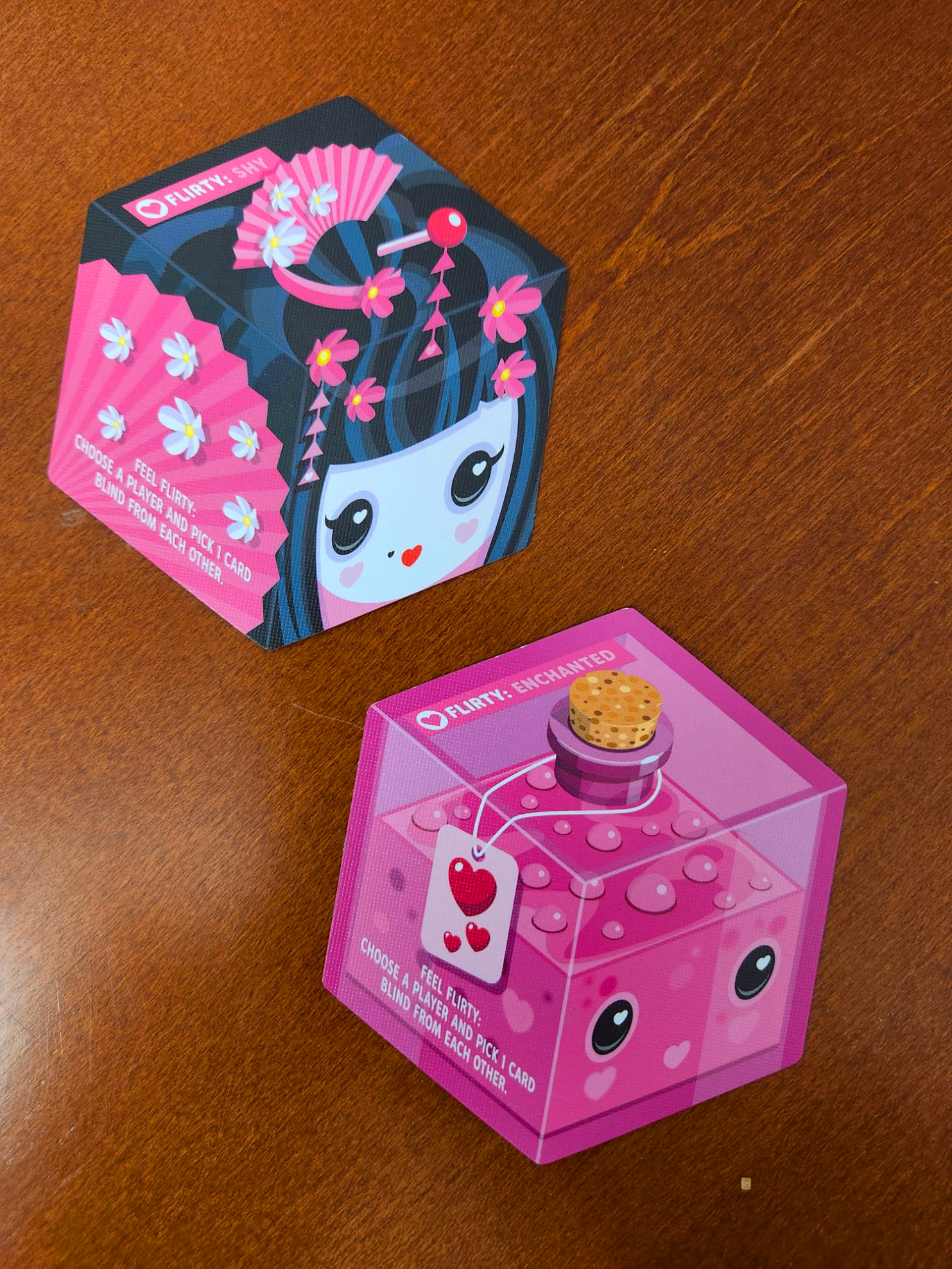
I removed 2 cards for flirty emotions
Student Experience
Overall Score: 50% overall effectiveness + 30% engagement score + 20% bonding score
3.65 / 5
Engagement Score:
Average of the following scores:
Interest, Enjoyment, Motivation, Engagement, Effort
3.94 / 5
Bonding Score:
Average of the following scores:
Welcoming, Interaction,
Connection, Relatedness
3.39 / 5
% Students Who Felt Excluded:
0
% Average group size
5.31
Favorite Game: % students who voted
1.92
number of students who voted
2
More Ratings:
Click Here for breakdown of engagement and bonding scores
Sample size for this game's ratings:
16
Cerebria
Teacher Notes
Related Topics:
Lifespan Development, Developmental Psychology, Emotions
Learning Objective:
Emotion can be a motivator and guiding tool. It can tell us how we feel about our circumstances and motivate us to change or maintain our circumstances. For example, cognitive behavioral therapy is based on the idea that our thoughts can determine our emotions and our emotions can dictate our behavior.
Discussion Questions:
- How did the emotions that came up sway the decisions or actions you made?
- Student: The emotions that came up swayed the decions or actions I made greatly. If I got Bliss emotions, I was focused on positivity and building areas that aligned with out team's goal. If I got Gloom emotions I used them to take control from other teams and disrupt them. These emotions effected the strategy and moves I made throughout the game.
- Teacher: The emotions that come into play changed my focus as a player. For example, positive emotions (Bliss) allowed me to concentate on my original goal whereas negative emotions (Gloom) were distracting and set another goal in between me and my original goal. Now, I would need to focus on more than myself to restore the game to equilibrium.
-
What emotional regulation strategies were used?
- Student: Some emotional regulation stratergies used were mindfulness, stay grounded and cognitive reappraisal
- Teacher: In the game, lots of things can change very quickly. Even the collection of Bliss vs. Gloom cards could change how one feels and the amount of pressure or stress within the game. Therefore, I needed to practice mindfulness and radical acceptance (e.g., what is done is done) in order to regulate my own emotions while playing the game.
Evaluations:
Teacher - △ Student - ▲
0
5
Commentary:
There are two versions of this game: one that is card based and one that is board game based. The card version, which we used, is a lot simpler than the board game version. The students found the rules a little hard to learn but once they learned the game, it seemed more fun than the Block Happy game.
Modifications:
⚪
No modifications needed
Student Experience
Overall Score: 50% overall effectiveness + 30% engagement score + 20% bonding score
3.07 / 5
Engagement Score:
Average of the following scores:
Interest, Enjoyment, Motivation, Engagement, Effort
3.16 / 5
Bonding Score:
Average of the following scores:
Welcoming, Interaction,
Connection, Relatedness
2.9 / 5
% Students Who Felt Excluded:
0
% Average group size
4.3
Favorite Game: % students who voted
0
number of students who voted
0
More Ratings:
Click Here for breakdown of engagement and bonding scores
Sample size for this game's ratings:
10
Feelinks
Teacher Notes
Related Topics:
Lifespan Development, Developmental Psychology, Emotions
Learning Objective:
People can have different emotional reactions to the same scenario. Being able to anticipate how other people would feel in a situation requires perspective taking and empathy. Anticipating the emotional reaction of others could create opportunities for social bonding, social support and conflict resolution.
Discussion Questions:
- Which scenarios did most players do a better job at guessing emotions on?
- Student: Any scenario which involved the feelings of either anger or irritation were fairly easy for people to guess. These are some of the more common emotions and people tend to feel irritation or anger towards the same things as other.
- Teacher: Negative emotions were easier for people to guess, especially when someone's rights were violated. People tended to agree that these situations are these emotions (e.g., angry) and angry was distinct enough from the other emotions (shock, embarrassment, disgust) for the particular situations.
-
Which scenarios did players have the most disagreement on how they would feel?
- Student: Scenerios related to friendships. When a friend does something embarressing as the situation, there was a variety of answers from being angry at them, irritated, feeling shame, and also feeling compassion for their emotions. This made sense as compassion related topics are more conterversal.
- Teacher: It seems like whenever there were situations that involved relationships or friendships between people, there were more variable responses. I think this reflects both what kinds of relationships the player is used to as well as their personality, whether they are more forgiving or not.
Evaluations:
Teacher - △ Student - ▲
0
5
Commentary:
This game was a lot of fun. Don't be fooled by the eccentric artstyle! It seemed like a game that would be too easy for college students, but the scenarios were relevant and/or amusing for students to flashback on. There were some tricky emotions within the games so there is enough variation in scoring per round. This game is probably best played after the students have gotten to know each other, since they need to guess how their partners would feel with each scenario.
Modifications:
⚪
No modifications needed
Student Experience
Overall Score: 50% overall effectiveness + 30% engagement score + 20% bonding score
4 / 5
Engagement Score:
Average of the following scores:
Interest, Enjoyment, Motivation, Engagement, Effort
4.12 / 5
Bonding Score:
Average of the following scores:
Welcoming, Interaction,
Connection, Relatedness
3.78 / 5
% Students Who Felt Excluded:
0
% Average group size
5.5
Favorite Game: % students who voted
0
number of students who voted
0
More Ratings:
Click Here for breakdown of engagement and bonding scores
Sample size for this game's ratings:
8
Your Friend is Sad
Teacher Notes
Related Topics:
Lifespan Development, Developmental Psychology, Emotions, Counseling Skills
Learning Objective:
Social support is one of protective factors against developing depression and other mental health issues. Noticing when your friend is sad and what to do to support them could strengthen the bond you have with your friend.
Discussion Questions:
- What life challenges were the most relatable?
- Student: The challenges in the game that felt most relatable were the ones that come from everyday stress and feeling isolated. Things like being overwhelmed by too many tasks or emails are things most of us deal with regularly. The idea of feeling “forgotten” or disconnected also hit home, since everyone experiences loneliness or feeling out of touch with others at some point. And the way the game shows that sometimes we don’t know why we’re sad is super relatable—because a lot of times, emotions aren’t always easy to explain.
- Teacher: The social struggles that the main character of the game experienced were the most relatable. These situations involved feeling isolated or lonely, getting rejected, feeling nervous about social situations, etc.
-
What cheer-up strategies were the most effective or helpful?
- Student: The most effective strategies were the ones that connected emotionally, like giving a hug or a compliment. Those felt the most genuine, showing empathy and making the person feel seen. Humor worked well too—telling a funny joke or something silly really lightened the mood. Also, suggesting a distraction, like ice cream or a walk in nature, helped by taking the person’s mind off what was making them sad, which is exactly what we do in real life when we try to shift focus from negative thoughts.
- Teacher: The game showed all sorts of coping techniques, some that can be done alone (taking a walk) while others require other people (getting a hug, compliment or reassurance from a friend). I think all of these strategies could be effective, maybe some more reasonable and appropriate for certain situations.
Evaluations:
Teacher - △ Student - ▲
0
5
Commentary:
This game has a lot of great suggestions of mood lifters and stress reducers on the cards and could be a great way for students to think about their own mental health and how they can support their friends if they are feeling down. The game mechanics are a little tricky though, so the appropriateness of this game for class depends on class time and the game savvyness of your students. Students with less experience with games in general may be bogged down by the token or resource system.
Modifications:
⚪
No modifications needed
Student Experience
Overall Score: 50% overall effectiveness + 30% engagement score + 20% bonding score
3.43 / 5
Engagement Score:
Average of the following scores:
Interest, Enjoyment, Motivation, Engagement, Effort
3.87 / 5
Bonding Score:
Average of the following scores:
Welcoming, Interaction,
Connection, Relatedness
3.568 / 5
% Students Who Felt Excluded:
0.04
% Average group size
5.56
Favorite Game: % students who voted
0.96
number of students who voted
1
More Ratings:
Click Here for breakdown of engagement and bonding scores
Sample size for this game's ratings:
18
Fluxx 5.0
Teacher Notes
Related Topics:
Cognitive Psychology, Sensation & Perception, Thinking, Learning & Memory, Clinical Psychology, Counseling Skills
Learning Objective:
Learning builds off of previous events. Learning a new rule may be easier or harder depending on how often the rule applies and what the consequences are.
Discussion Questions:
- What kinds of learning or conditioning exists in this game? Give examples.
- Student: The type of learning in the game was observational learning. With new rules being played almost every turn or the rules being changed almost every turn, the only way to figure out what to do was to observe what was being played and what others were doing to make sure you were caught up on the rules. For example, someone playing a rule that limited keeper cards that you had to pay attention to if you had more than 4 keeper cards.
- Teacher: Associative learning exists between the icons and their utility value for a goal or in card/position and the rule. Then, there is attentional or perceptual learning, or the ability to detect the icon that you are looking for quickly from your tiles. Mainly, there is operant conditioning, where the reward is feeling prideful or successful (others cheering or sulking) in completing a goal and the punishment is being called out for interpretting the rules wrong or forgetting about a rule that disallows an action.
-
What were the qualities of the rules that were easier or harder to learn? Think about the reinforcement schedules and reward vs. punishment.
- Student: The hardest part of the rules was keeping track of all the rules that were added. There werer rules that did not go in the draw or play spots and when there were more than 3 it was hard to keep track of them. The draw and play rules were fairly simple because I could look where they were and easily see what I needed to do or not to do. I did not necissarily feel that most of the rules were a reward or punishment. The outlier to that would be the extreme cards such as playing all but one card which rewarded a large hand size or the max keepers rule which punished playing a lot of keepers. More than anything I think the action cards were the most confusing.
- Teacher: Qualities of cards that were hard to keep track of is when there are edge cases or very few or unique circumstances where the rule triggers. It i much easier to keep track of a rule that is looking at the odd or evenness of a number for example. Reinforcement seems to be variable ratio. Players' attention and interest are spotty. Not every single time someone successfully triggers a rule or accidentally forgets is there verbal commentary from the other players. Not every single time there is an actual rule violation is it caught.
Evaluations:
Teacher - △ Student - ▲
0
5
Commentary:
Fluxx 5.0 is an improved version of the original fluxx game, with no specific theme associated with it. Most of the cards are everyday objects, so the game can be used for discussing category learning, concept learning, etc. Students did find the changing rules a little frustrating because they did not know how they should be shifting gears. Playing this game multiple classes may be helpful to offset this. I could also see this game being used as a metaphor about live and to teach students about adapatability.
Modifications:
⚪
No modifications needed
Student Experience
Overall Score: 50% overall effectiveness + 30% engagement score + 20% bonding score
3.09 / 5
Engagement Score:
Average of the following scores:
Interest, Enjoyment, Motivation, Engagement, Effort
2.98 / 5
Bonding Score:
Average of the following scores:
Welcoming, Interaction,
Connection, Relatedness
3.27 / 5
% Students Who Felt Excluded:
0
% Average group size
4.14
Favorite Game: % students who voted
0
number of students who voted
0
More Ratings:
Click Here for breakdown of engagement and bonding scores
Sample size for this game's ratings:
7
Fluxx Across America
Teacher Notes
Related Topics:
Cognitive Psychology, Sensation & Perception, Thinking, Learning & Memory
Learning Objective:
Learning builds off of previous events. Learning a new rule may be easier or harder depending on how often the rule applies and what the consequences are.
Discussion Questions:
- What kinds of learning or conditioning exists in this game? Give examples.
- Student: Operant conditioning exists in this game as the cards you play and decisions you make will either reward or punish you in some way. For example, if you played a keeper card, and then it shortly after became a goal to have that keeper, you would feel the punishment as you missed an opportunity to meet that goal. At the same time, if you keep track of all the cards in your hand, you will be able to manipulate the rules and goals in your favor.
- Teacher: Associative learning exists between the icons and their utility value for a goal or in card/position and the rule. Then, there is attentional or perceptual learning, or the ability to detect the icon that you are looking for quickly from your tiles. Mainly, there is operant conditioning, where the reward is feeling prideful or successful (others cheering or sulking) in completing a goal and the punishment is being called out for interpretting the rules wrong or forgetting about a rule that disallows an action.
-
What were the qualities of the rules that were easier or harder to learn? Think about the reinforcement schedules and reward vs. punishment.
- Student: It was easy to grasp the general idea of the game, as it simply consisted of drawing and then playing cards each turn. The difficult part was the fact that the game starts with no rules and no way to win the game, and they are created as players play cards. This requires you to always be paying attention as the rules and objectives could change at any moment.
- Teacher: Qualities of cards that were hard to keep track of is when there are edge cases or very few or unique circumstances where the rule triggers. It i much easier to keep track of a rule that is looking at the odd or evenness of a number for example. Reinforcement seems to be variable ratio. Players' attention and interest are spotty. Not every single time someone successfully triggers a rule or accidentally forgets is there verbal commentary from the other players. Not every single time there is an actual rule violation is it caught.
Evaluations:
Teacher - △ Student - ▲
0
5
Commentary:
This is a pretty basic version of Fluxx that could be nice to use if your students come from all over the country. This could be a nice ice breaker game or reference activity for later discussions about learning, problem solving and decision making.
Modifications:
⚪
No modifications needed
Student Experience
Overall Score: 50% overall effectiveness + 30% engagement score + 20% bonding score
3.4 / 5
Engagement Score:
Average of the following scores:
Interest, Enjoyment, Motivation, Engagement, Effort
3.68 / 5
Bonding Score:
Average of the following scores:
Welcoming, Interaction,
Connection, Relatedness
3.53 / 5
% Students Who Felt Excluded:
0
% Average group size
4.56
Favorite Game: % students who voted
0
number of students who voted
0
More Ratings:
Click Here for breakdown of engagement and bonding scores
Sample size for this game's ratings:
9
Fluxx The Board Game
Teacher Notes
Related Topics:
Cognitive Psychology, Sensation & Perception, Thinking, Learning & Memory
Learning Objective:
Learning builds off of previous events. Learning a new rule may be easier or harder depending on how often the rule applies and what the consequences are.
Discussion Questions:
- What kinds of learning or conditioning exists in this game? Give examples.
- Student: The type of learning that exists are quick decisions making as for eample when you move your piece to fulfill a goal you have to quickly move your pieces to achieve this and come up with decisions fast in order to keep the game running smoothly. Also you need to be able to quikcly interpret what the action cards and make needed changes to positvely effect your pieces like rotating tiles to benefit you. Which is why I categorize this game as a quick thinking and decisions making game.
- Teacher: Associative learning exists between the icons and their utility value for a goal or in card/position and the rule. Then, there is attentional or perceptual learning, or the ability to detect the icon that you are looking for quickly from your tiles. Mainly, there is operant conditioning, where the reward is feeling prideful or successful (others cheering or sulking) in completing a goal and the punishment is being called out for interpretting the rules wrong or forgetting about a rule that disallows an action.
-
What were the qualities of the rules that were easier or harder to learn? Think about the reinforcement schedules and reward vs. punishment.
- Student: The rules that were hardest to learn were understanding the plays, move, and draw. What was hard to learn/undertsand was this meaning you could only move one piece that set amount of spaces or that is the total amount of moves you could make across all of your pieces. For the draw rule it was hard to understand wether it meant draw at the very beginning or at the end after playing. Finally, the plays was confusing as it didn't specify if you had to make that many plays or oyu could play up to that limit. Through the reward and punishment form making these actions I was able to learn them.
- Teacher: Qualities of cards that were hard to keep track of is when there are edge cases or very few or unique circumstances where the rule triggers. It i much easier to keep track of a rule that is looking at the odd or evenness of a number for example. Reinforcement seems to be variable ratio. Players' attention and interest are spotty. Not every single time someone successfully triggers a rule or accidentally forgets is there verbal commentary from the other players. Not every single time there is an actual rule violation is it caught.
Evaluations:
Teacher - △ Student - ▲
0
5
Commentary:
This version of Fluxx is the most complex of the ones that we tried. Instead of being based on cards only, this game incorporates a changing board which is made up of changing tiles. This adds a level of complexity and could be appropriate to use if it is used after having played a basic version of Fluxx like the others in this list.
Modifications:
⚪
No modifications needed
Student Experience
Overall Score: 50% overall effectiveness + 30% engagement score + 20% bonding score
2.95 / 5
Engagement Score:
Average of the following scores:
Interest, Enjoyment, Motivation, Engagement, Effort
3.02 / 5
Bonding Score:
Average of the following scores:
Welcoming, Interaction,
Connection, Relatedness
3.49 / 5
% Students Who Felt Excluded:
0
% Average group size
3.88
Favorite Game: % students who voted
0
number of students who voted
0
More Ratings:
Click Here for breakdown of engagement and bonding scores
Sample size for this game's ratings:
8
Pavlov's Dogs
Teacher Notes
Related Topics:
Cognitive Psychology, Sensation & Perception, Thinking, Learning & Memory
Learning Objective:
Classical conditioning is a learning process in which a neutral stimulus elicits an unconditioned response after repeated pairings with an unconditioned stimulus. This type of learning is relevant when teaching dogs tricks.
Discussion Questions:
- Name the elements of conditioning that exist in this game.
- Student: The elements of conditioning that exist in this game include operational conditioning, positive reinforcement via the phrase Good dog and being given a bone, and conditioned responses that form in response to 'neutral' stimuli in the form of the cards that are pulled up. We become conditioned to react to the neutral stimulus in order to try and win bones.
- Teacher: Pavlov's dogs the game is inspired by Pavlov's dogs. It's a bit silly but has players follow commands based on cards and remember the previous commands. The game mechanics definitely leans more operant conditioning than classical conditioning. Commands include: speak, shake sit, beg, fetch, roll. There is a neutral stimulus introduced that is the bell, but basically, players learn the rules of the "trainer" based on reward (praise "good dog") or punishment (being "scolded": bad dog, and negative punishment: taking a bone away).
-
What were the reward or punishment in this game? Was the reinforcement schedule ideal to learn the rules?
- Student: The reward for following the rule was for the dogtor to tell them good dog for following the rules. The punishment for not following the rules is the dogtor telling them bad dog and taking one of their bones. the dog (player) loses when they lose all 3 of their bones. The reinforcement schedule was mostly ideal for learning the rules since the punishment has actual consequences in the game, but one could argue that the rewards aren't ideal for learning since they don't seem to have a real reward, just a verbal one.
- Teacher: Reward was "good dog" (positive reinforcement) and punishment was "bad dog" (positive punishment) and taking away a bone (negative punishment). The reinforcement schedule is fixed ratio because the dogtor/trainer rewarded or punished the "dog" any time that they did a good or bad job.
Evaluations:
Teacher - △ Student - ▲
0
5
Commentary:
This game could feel a little silly to the students so it's important to introduce this game later into the academic term once they have gotten more familiar and comfortable with each other. The rules include calling players "good dog" and "bad dog" as forms of rewards and punishment, so the students would need to be comfortable saying this to one another. Of course, these rules could be modified by the instructor how they see fit. I can see this game being incorporated into a lesson on classical and operant conditioning and it has nice ties to Ivan Palvov's experiment with his dog. The instructor can then hold a discussion after gameplay labeling the elements of the game with the relevant psychology terms.
Modifications:
⚪
No modifications needed
Student Experience
Overall Score: 50% overall effectiveness + 30% engagement score + 20% bonding score
3.67 / 5
Engagement Score:
Average of the following scores:
Interest, Enjoyment, Motivation, Engagement, Effort
3.8 / 5
Bonding Score:
Average of the following scores:
Welcoming, Interaction,
Connection, Relatedness
3.92 / 5
% Students Who Felt Excluded:
0
% Average group size
5.3
Favorite Game: % students who voted
0
number of students who voted
0
More Ratings:
Click Here for breakdown of engagement and bonding scores
Sample size for this game's ratings:
10
We Didn’t Playtest This at All
Teacher Notes
Related Topics:
Cognitive Psychology, Sensation & Perception, Thinking, Learning & Memory
Learning Objective:
Learning builds off of previous events. Learning a new rule may be easier or harder depending on how often the rule applies and what the consequences are.
Discussion Questions:
- What kinds of learning or conditioning exists in this game? Give examples.
- Student: The game primarily uses operant conditioning through unpredictable mechanics and super random events. The sudden addition of different rules results in immediate consequences which reinforces many different behaviors, teaching everyone to adapt quickly and try to predict the way that the game works. For example, one card kept popping up and making everyone pick rock paper and scissors and then whoever picked paper lost, so by the third time, nobody picked paper anymore.
- Teacher: A good amount of the game is operant conditioning, as one is motivated by rewards and punishment of following or violating rules and engagement in the game is voluntary. However, there are some possibilities for classical conditioning. For example, if someone always messes up removing a word from their vocabulary (e.g., you are no longer able to use the word "I"), then they may learn a fear response to the word "I" from the repeated shaming that happens when they say the word "I" accidentally. This fear or hesistance response could continue past the time that that rule is in play.
-
What were the qualities of the rules that were easier or harder to learn? Think about the reinforcement schedules and reward vs. punishment.
- Student: Some of the easier qualities were that the rules were instantaneous and easily applicable. Some of the harder qualities were that from that nuance stemmed a lot of uncertainty about the game and it was hard to keep track of all of the different rules that popped up throughout the game. There was also no reinforcement to certain rules which made it harder to keep track of what everything was supposed to be.
- Teacher: The rules that are easiest to learn are the ones that have many opportunities for learning, such as ones that restricts one's speech as one would naturally talk during the game and would face consequences quickly from violating the rule. Rules that are harder to learn are the ones that one can forget to track after a while because it triggers rarely.
Evaluations:
Teacher - △ Student - ▲
0
5
Commentary:
This game can get really chaotic fast and thus, was polarizing. Some students liked that the game was always changing, others were frustrated that there was so many rules to track.
Modifications:
⚪
No modifications needed
Student Experience
Overall Score: 50% overall effectiveness + 30% engagement score + 20% bonding score
3.84 / 5
Engagement Score:
Average of the following scores:
Interest, Enjoyment, Motivation, Engagement, Effort
3.91 / 5
Bonding Score:
Average of the following scores:
Welcoming, Interaction,
Connection, Relatedness
3.6 / 5
% Students Who Felt Excluded:
0.02
% Average group size
5.56
Favorite Game: % students who voted
4.81
number of students who voted
5
More Ratings:
Click Here for breakdown of engagement and bonding scores
Sample size for this game's ratings:
29
Memory Mayhem
Teacher Notes
Related Topics:
Cognitive Psychology, Learning & Memory
Learning Objective:
People have two working memories: visuospatial sketchpad (visual) and phonological loop (verbal/phonological). To store things in memory, people need to convert information in their working memory into long term memory. There can be order effects depending on the sequence of memorization. You can remove the recency effect by having people do a distractor task.
Discussion Questions:
- What strategy did you use to memorize the numbers and objects on the cards? How did it work out?
- Student: I used a chunking strategy to group similar objects and numbers together, which helped me remember more efficiently, and it worked fairly well in organizing the information. However, I found it challenging to maintain focus on all the details.
- Teacher: Because the tiles are everyday objects and I am familiar with most of them, it was easy to use the chunking strategy and group them based on purpose, context, or category. Most of the words for the tiles are short so I could use maintainence rehearsal with my phonological loop. The game also included a distractor task that was decided based on a die. This cleared most of the items stored in my short-term/working memory but I was able to retain and recall most from my long-term memory. The amount of time allotted was enough to see the distinction between the first few items I rehearsed and the last few items that I rehearsed
-
What did you notice about what you remember after you completed the naming task? Did you remember less or misremember locations?
- Student: After completing the task, I noticed that I tended to remember the general placement of objects but often misremembered specific locations or confused similar-looking items. I also recalled fewer details than expected.
- Teacher: The task seemed easier enough but when I actually started playing the game, I realized how hard the task was. Misremembered details could be remembering a general location instead of a specific location, a general category instead of the actual item, misremembering a word that rhymes with the actual word (acoustic similarity) or is symantically similar (e..g, DRM effect).
Evaluations:
Teacher - △ Student - ▲
0
5
Commentary:
This game has enough elements of the memory section of either Intro Psychology or Cognitive Psychology that I can see it being used after or before a lecture on the topic. The instructor can talk about types of working memory, memory effects (primacy and recency effect), the purpose of a distractor task, memory mistakes (e.g., visual or phonological similarities), and maybe even availability heuristic (e.g., if for the distractor task, the player is asked to name words that start with "r"). Overall, I think this game has a nice balance of learning opportunity and fun and the rules are simple enough to learn.
Modifications:
⚪
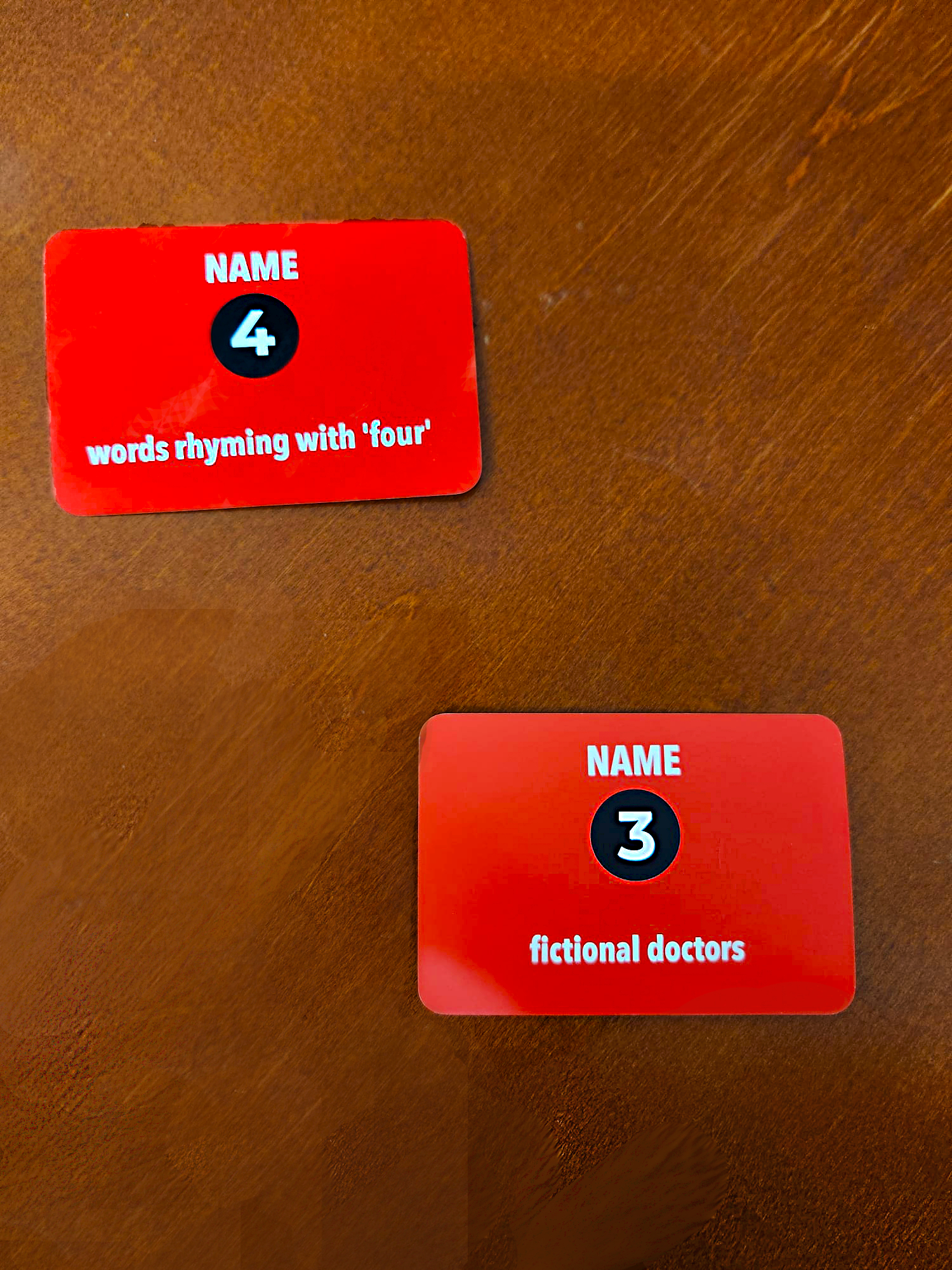
I removed 4 cards for sexual content or cuss words
Student Experience
Overall Score: 50% overall effectiveness + 30% engagement score + 20% bonding score
4.11 / 5
Engagement Score:
Average of the following scores:
Interest, Enjoyment, Motivation, Engagement, Effort
4.09 / 5
Bonding Score:
Average of the following scores:
Welcoming, Interaction,
Connection, Relatedness
3.61 / 5
% Students Who Felt Excluded:
0.18
% Average group size
5.71
Favorite Game: % students who voted
0.96
number of students who voted
1
More Ratings:
Click Here for breakdown of engagement and bonding scores
Sample size for this game's ratings:
17
Parks Memories: Mountaineers
Teacher Notes
Related Topics:
Cognitive Psychology, Learning & Memory
Learning Objective:
When viewing images, we first use sensory memory and then visual working memory to keep them in mind. We need to convert this into long term memory in order to recall them for later. You may use chunking or elaborative processing in order to remember them better.
Discussion Questions:
- What memory techniques did you use for remembering the tiles? What worked and what didn’t work?
- Student: The best technique I used was repetition for remembering the tiles, looking at its type and repeating it in my head multiple times. I'd then continue repeating the entire column and then grid to try to remember the types of each card (each card has a type that you need 3 of in order to win). Remembering by the image on the card or the name on it was difficult and nearly impossible so I gave up that approach rapidly.
- Teacher: I felt like rehearsal was the only strategy that was possible for this game as the tiles can vary a lot. Even then, it took a good amount of visual memory which I am not the best at. When it was possible, I would try to use chunking or some kind of story to remind myself of the order of the tiles, but I do not know the national parks that well so it would be hard to group them by location (state, east/west) or by popularity.
-
What mistakes did you make? What may this be? Are the tiles confusable or are you getting the location wrong?
- Student: I'm mainly getting the location wrong (really just forgeting what type of card is in each spot). The tiles themselves are pretty distinct and have a symbol that make it easy to know which type they are.
- Teacher: While I could get the tiles correctly most of the time, the location of the tile I might mess up here and there. Usually it's a proximal swap, like this corner instead of the other corner, or still this side (left/right) but a different location, but it is a large cognitive load to remember these unfamiliar images AND the location of the images.
Evaluations:
Teacher - △ Student - ▲
0
5
Commentary:
The students like this game a lot. The art is beautiful and the items to remember are good for learning more about (U.S.) geography (e.g., such as national parks). I have heard some students complain that it does take some practice to get the hang of the game, but afterwards, it is fun to play and rather challenging - requiring them to use the memory techniques they learned in class.
Modifications:
⚪
No modifications needed
Student Experience
Overall Score: 50% overall effectiveness + 30% engagement score + 20% bonding score
3.57 / 5
Engagement Score:
Average of the following scores:
Interest, Enjoyment, Motivation, Engagement, Effort
3.39 / 5
Bonding Score:
Average of the following scores:
Welcoming, Interaction,
Connection, Relatedness
3.49 / 5
% Students Who Felt Excluded:
0.03
% Average group size
4.83
Favorite Game: % students who voted
4.81
number of students who voted
5
More Ratings:
Click Here for breakdown of engagement and bonding scores
Sample size for this game's ratings:
24
Hues and Cues
Teacher Notes
Related Topics:
Cognitive Psychology, Sensation & Perception
Learning Objective:
Perception of color category boundaries is culture-dependent but specific hues are even more subjective and experience-dependent
Discussion Questions:
- What kinds of cues were most effective (i.e., consistent/similar responses)?
- Student: The cues that were most accturate would be the ones everyone related to, and that had the most common ground with people. I.E. related to water, or the sky, or the grass. The things that are pretty universal for everyone no matter who they are.
- Teacher: I found that using clues that are associated with food, brands, or common objects was the best for getting the most accurate guesses. We are taught associations between certain hues and brands or food (e.g., mac and cheese has a certain color of yellow, wendys and burger king is associated with certain colors/hues, so does condimennts; illustrations of common objects like like the sun, sky, ocean and trees tend to choose the same hues as well). Using clues that have consistent hues to represent the objects across the world was the most reliable.
-
Were there color ranges or hues that had the most variable responses? Why may this be?
- Student: The colors that had the most range in response tended to be the pinks and oranges. I believe this is due to not being able to think of a common ground for these colors and they are not as naturally occurring compared to blue and green. The hints given for these tended to be more subjected to each person
- Teacher: I found that clues for more artificial or less naturally occurring colors were less effective, but this could also be because we have less vocabulary for colors in the pinks, browns, orange, and purple range. Without a specific interest in these colors (e.g., favorite color: a particular shade of purple instead of the others), we do not usually make a huge distinction between the different hues of the color. While we can tell that the hues are different (e.g., warmer or cooler, more saturated or less), we do not have strong associations between those hues and objects or ideas. I believe that is why it is hard to communicate which exact pink or orange we are referring to. Pink is usually seen in flowers and orange is usually the same shade of orange that we see in oranges, tangerines, clementines, etc. Other oranges are maybe occuring less frequently in our everyday life.
Evaluations:
Teacher - △ Student - ▲
0
5
Commentary:
This game can easily be incorporated into talking about linguistic determinism and linguistic relativism, especially when discussing how different cultures have different labels and color boundaries for certain shades of green and blue. The map of colors is very similar to the ones depicted in those studies. For a post-gameplay discussion, the instructor can talk about how prior knowledge could even include perceiving and identifying certain hues, e.g., periwinkle is a valid clue in the game because it does not use the word "purple" and would be a really good clue for those who know the names of purple hues and very confusing for those who do not.
Modifications:
⚪
No modifications needed
Student Experience
Overall Score: 50% overall effectiveness + 30% engagement score + 20% bonding score
4.15 / 5
Engagement Score:
Average of the following scores:
Interest, Enjoyment, Motivation, Engagement, Effort
4.41 / 5
Bonding Score:
Average of the following scores:
Welcoming, Interaction,
Connection, Relatedness
3.42 / 5
% Students Who Felt Excluded:
0
% Average group size
6.33
Favorite Game: % students who voted
8.65
number of students who voted
9
More Ratings:
Click Here for breakdown of engagement and bonding scores
Sample size for this game's ratings:
21
Set
Teacher Notes
Related Topics:
Cognitive Psychology, Sensation & Perception
Learning Objective:
Binding features requires attention. Serial search is used to check for common and differing features.
Discussion Questions:
- What strategies were you using to complete the task?
- Student: Elimination: When I find two cards that match in most of their attributes, but can't find a third to complete the set, I quickly eliminate them and move on so I can avoid getting stuck with mismatched cards.Grouping: I sometimes group cards with similar attributes together to lighten the load on my brain and to quickly spot differences or matches in these small groups.
- Teacher: I can tell that this game is meant for us to have a real life example of the feature integration theory, where attention is needed when looking for combination of features. We either see the color feature or the shape feature at a time and need to combine the features in order to detect something we are looking for. This must be why this task was hard to do. It required a lot of concentration and resulted in some false positives, thinking that I found a set when I did not because one feature was duplicated.
-
What cognitive abilities are you using? E.g., attention.
- Student: I would say that I was using the cognitive skills of pattern recognition to find the patterns among sets, visual processing, decision making, spatial ability to keep track of what cards were located in relation to others, and my short term memory to keep track of potential matches.
- Teacher: This game required accurate color perception (i.e., hard to play if one is color blind), attention (specifically feature binding), serial search (checking each card for a card that matches your requirements), inhibitory control (to not pick based on similarity or to not be too quick to select a set without checking that you do in fact have a valid set).
Evaluations:
Teacher - △ Student - ▲
0
5
Commentary:
This game is very simple to learn and understand. It's a nice way to get students to complete multiple "trials" of a visual attention/perception experiment in an "accidental" and fun way as opposed to completing a traditional experimental task. In addition, students can observe and learn from each other what trips people up when it comes to picking out a set with unique and non-overlapping features. This way of discussing feature binding could feel more concrete and graspable to students.
Modifications:
⚪
No modifications needed
Student Experience
Overall Score: 50% overall effectiveness + 30% engagement score + 20% bonding score
4.03 / 5
Engagement Score:
Average of the following scores:
Interest, Enjoyment, Motivation, Engagement, Effort
3.97 / 5
Bonding Score:
Average of the following scores:
Welcoming, Interaction,
Connection, Relatedness
3.46 / 5
% Students Who Felt Excluded:
0
% Average group size
5.5
Favorite Game: % students who voted
4.81
number of students who voted
5
More Ratings:
Click Here for breakdown of engagement and bonding scores
Sample size for this game's ratings:
14
That Sound Game
Teacher Notes
Related Topics:
Cognitive Psychology, Sensation & Perception
Learning Objective:
Sounds (of the same kind) have a wide range of acoustics. People use a typical or prototypical sample to represent the category.
Discussion Questions:
- What was your thought process when giving the clues?
- Student: My thought process when I was giving the clues was thinking about what the sound would sound like in a cartoon and try and make it sound like that to try and give the other players a easy clue.
- Teacher: I tried to mimic the well-known sounds as much as I could. For more abstract sounds, I tried to piece together different sounds to give the gist of what the sound would represent. This was a lot more difficult. Whether a concrete or abstract sound, I was still limited by what I can produce vocally.
-
What was your thought process when guessing the sound?
- Student: when trying to geuss what is on the card I think about the sound that was made with my eyes closed and use whatever I picture when I hear the sound and consider the category that the card is.
- Teacher: For the sounds that sounded like literal interpretations of the word, it was much easier to guess and I tried to imagine what the intended sound sounded like, especially if I noticed the clue giver had a difficult time making the sound that they intended. For the more hesistant clues or the more confused clue giver, I would try to think about what abstract or less concrete word they may be portraying, kind of what you would do in pictionary.
Evaluations:
Teacher - △ Student - ▲
0
5
Commentary:
This game can be good in theory but I highly suggest the instructor to go through and pick out cards that are easier to make sounds for. While there are not a lot of inappropriate cards, there are a lot of cards that require knowing pop culture references which could be exclusionary for international students, and a lot of cards that are simply hard to make sounds for. The latter cards would then have very little education value.
Modifications:
⚪
I removed 12 cards for awkward or difficult to mimic sounds
Student Experience
Overall Score: 50% overall effectiveness + 30% engagement score + 20% bonding score
3.67 / 5
Engagement Score:
Average of the following scores:
Interest, Enjoyment, Motivation, Engagement, Effort
4.19 / 5
Bonding Score:
Average of the following scores:
Welcoming, Interaction,
Connection, Relatedness
3.85 / 5
% Students Who Felt Excluded:
0
% Average group size
5.8
Favorite Game: % students who voted
0
number of students who voted
0
More Ratings:
Click Here for breakdown of engagement and bonding scores
Sample size for this game's ratings:
10
Comanauts
Teacher Notes
Related Topics:
Cognitive Psychology, Sleep Disorders, Sleep & Dreams
Learning Objective:
A coma is a state of severely reduced or absent consciousness in which an individual is alive but unable to respond to the environment.
Discussion Questions:
- How does our emotions relate to our dreams and vice versa?
- Student: Our emotions affect our dreams, and our dreams can affect how we process our emotions
- Teacher: Our dreams can reflect the types of emotions that we actually had or had surpressed during our day. The types of emotions we had during the day could influence what types of dreams we have at night. Our dreams, even if they are unrelated to our day events, could also make us feel real emotions.
-
How does our dreams relate to what is going on in our lives? And the problems we face and the solutions we look for?
- Student: Our dreams can refect our current concerns as well as possible soultions we can use to resolve these confilcts
- Teacher: Sometimes dreams can be about the last few things that we were thinking about during the day or last few things that has happened. These dreams would support the hypothesis that dreams are a way of processing events for memory consolidation. Sometimes longstanding problems that we are processing in our consciousness transfer into our dreams, sometimes we are able to work through the problem within the dream, sometimes the solutions are unrealistic once we wake up.
Evaluations:
Teacher - △ Student - ▲
0
5
Commentary:
This game has a very extensive rule book and unfortunately did not have as many (discussion) elements of comas and vegetative states as I had hoped. The students did spend most of the class time reading and understanding the rules as opposed to playing the game and being able to extract out the course-relevant components for discussion.
Modifications:
⚪
No modifications needed
Student Experience
Overall Score: 50% overall effectiveness + 30% engagement score + 20% bonding score
2.34 / 5
Engagement Score:
Average of the following scores:
Interest, Enjoyment, Motivation, Engagement, Effort
3.17 / 5
Bonding Score:
Average of the following scores:
Welcoming, Interaction,
Connection, Relatedness
3.24 / 5
% Students Who Felt Excluded:
0
% Average group size
4.5
Favorite Game: % students who voted
0.96
number of students who voted
1
More Ratings:
Click Here for breakdown of engagement and bonding scores
Sample size for this game's ratings:
3
Dream On
Teacher Notes
Related Topics:
Cognitive Psychology, Sleep Disorders, Sleep & Dreams
Learning Objective:
Dreams most commonly occur during REM (Rapid Eye Movement) sleep, a stage of the sleep cycle characterized by heightened brain activity, vivid imagery, and temporary muscle paralysis.Themes that appear in dreams often reflect personal experiences, emotions, and concerns, with common motifs including being chased, falling, flying, or navigating social interactions, which may serve to process unresolved thoughts or emotions.
Discussion Questions:
- What are some common themes that exist in our dreams? How does that relate to our needs, wants and fears as humans?
- Student: Dreams often feature universal themes like falling, being chased, or finding oneself unprepared, symbolizing deep-seated emotions and unresolved issues. These themes reflect core human experiences, such as anxiety, desire, and the need for control. Our dreams mirror our subconscious needs, wants, and fears, providing a safe space for us to confront hidden emotions.
- Teacher: Our dreams can have common themes from our waking day, such as people we have talked to, situations we have experienced, or places we have been. Dreams can also be a reflection of strong or unprocessed emotions from our day, such as fears about our relationship (e.g., our partner is cheating on us), fears about failing an exam (e.g., showing up to an exam unprepared and struggling on each question), or fears that we are avoiding (e.g., running away from our problems). Dreams could also be wishful thinking, such as flying or going to a buffet. There's also sleep paralysis, where the sleeper is caught in between sleep stages and their body is asleep while their mind is awake still. Our mind usually interprets this as some form of nightmare.
-
How does our dreams relate to what is going on in our lives? And the problems we face and the solutions we look for?
- Student: Dreams are often influenced by recent events and unresolved challenges, replaying situations we faced during the day in symbolic ways. They can reveal our true feelings about people, decisions, or obstacles that might be harder to face in waking life. Our minds sometimes solve problems in dreams, as they work through scenarios and emotions without conscious limits. Dreams can inspire solutions or new perspectives, acting as a creative, risk-free testing ground for life's issues.
- Teacher: Sometimes dreams can be about the last few things that we were thinking about during the day or last few things that has happened. These dreams would support the hypothesis that dreams are a way of processing events for memory consolidation. Sometimes longstanding problems that we are processing in our consciousness transfer into our dreams, sometimes we are able to work through the problem within the dream, sometimes the solutions are unrealistic once we wake up.
Evaluations:
Teacher - △ Student - ▲
0
5
Commentary:
This game is a good vehicle to talk about dreams and the different theories for why we have dreams. There are some cards that are very common motifs amongst dreams while others seem more random, arbitrary, or subjective, which aligns well with how some dreams seem nonsensical and do not relate to what happened during the day or what is being thought about on an unconscious level.
Modifications:
⚪
No modifications needed
Student Experience
Overall Score: 50% overall effectiveness + 30% engagement score + 20% bonding score
3.98 / 5
Engagement Score:
Average of the following scores:
Interest, Enjoyment, Motivation, Engagement, Effort
4.25 / 5
Bonding Score:
Average of the following scores:
Welcoming, Interaction,
Connection, Relatedness
3.63 / 5
% Students Who Felt Excluded:
0
% Average group size
5.77
Favorite Game: % students who voted
1.92
number of students who voted
2
More Ratings:
Click Here for breakdown of engagement and bonding scores
Sample size for this game's ratings:
13
Dream Runners
Teacher Notes
Related Topics:
Cognitive Psychology, Sleep Disorders, Sleep & Dreams
Learning Objective:
Dreams most commonly occur during REM (Rapid Eye Movement) sleep, a stage of the sleep cycle characterized by heightened brain activity, vivid imagery, and temporary muscle paralysis.Themes that appear in dreams often reflect personal experiences, emotions, and concerns, with common motifs including being chased, falling, flying, or navigating social interactions, which may serve to process unresolved thoughts or emotions.
Discussion Questions:
- How do the nightmares we have relate to the obstacles that we face in real life?
- Student: Nightmares can often times give us insights into what we find threatening and unresolved in our actual lives, which usually highlights what we need to focus on. While nightmares can often times signal areas where we can grow, adapt, and gain confidence, it can help us overcome difficult challenges we have in life
- Teacher: Nightmares can be very literal or figurative. Sometimes the nightmares could be about exactly what we are scared of, i.e., a big exam. other times it could be figurative and give us a clue about our emotional state, e.g., pressure, danger, embarrassment, but through a different or unrealistic context, e.g., being a high schooler again and being bullied even though you are not in high school anymore.
-
Do our dreams or nightmares help us realize or solve our real-life problems? If so, how?
- Student: While I have never experienced a relevation or learning something from a dream, my dreams do frequently motivate me, especially nightmares. For example, if I have a nightmare about sleeping through a class, I will set more alarms in real life to make sure that does not happen.
- Teacher: Nightmares about imminent events that we have not registered in our waking live are ways for us to be reminded of upcoming challenges and get motivated to work towards them. For example, I have a half-marathon that is 2 months out. While in the last few weeks I've thought about starting to train for it but haven't actually started the process, once I had a nightmare that I ran out of time to train for it and only got one practice run in before the real event, I realized that I really need to train for it so that I do not experience this in real life. The emotions associated with the nightmare felt real so it foreshadowed how I would feel if I did not prepare for the actual half-marathon.
Evaluations:
Teacher - △ Student - ▲
0
5
Commentary:
This game has good potential but I recommend the instructor have the students watch a video on how to play the game instead of or in addition to reading the rules a supplement. The game has a "sleep cycle" tracker where you progress through stages/hours of sleep and need to collect tiles in order to complete a dream or nightmare. However, I do believe the instructor should modify or add some supports to the gameplay so that the students do not get lost in the rules and the game mechanics and loose sight of the relevance to course curriculum.
Modifications:
⚪
No modifications needed
Student Experience
Overall Score: 50% overall effectiveness + 30% engagement score + 20% bonding score
2.96 / 5
Engagement Score:
Average of the following scores:
Interest, Enjoyment, Motivation, Engagement, Effort
3.13 / 5
Bonding Score:
Average of the following scores:
Welcoming, Interaction,
Connection, Relatedness
3.52 / 5
% Students Who Felt Excluded:
0
% Average group size
4.13
Favorite Game: % students who voted
0.96
number of students who voted
1
More Ratings:
Click Here for breakdown of engagement and bonding scores
Sample size for this game's ratings:
8
When I Dream
Teacher Notes
Related Topics:
Cognitive Psychology, Sleep Disorders, Sleep & Dreams
Learning Objective:
Dreams most commonly occur during REM (Rapid Eye Movement) sleep, a stage of the sleep cycle characterized by heightened brain activity, vivid imagery, and temporary muscle paralysis.Themes that appear in dreams often reflect personal experiences, emotions, and concerns, with common motifs including being chased, falling, flying, or navigating social interactions, which may serve to process unresolved thoughts or emotions.
Discussion Questions:
- What are some common themes that exist in our dreams? How does that relate to our needs, wants and fears as humans?
- Student: Our dreams commonly depict our fears, desires, embarissing moments, and exciting moments though at times, dreams can also be very abstract with no distinct connection to what may be going on in our lives. Dreams relate to our needs, fears, and desires as humans bacause they sort of reflect what is currently on our conscience and may be weighing us down.
- Teacher: Our dreams can have common themes from our waking day, such as people we have talked to, situations we have experienced, or places we have been. Dreams can also be a reflection of strong or unprocessed emotions from our day, such as fears about our relationship (e.g., our partner is cheating on us), fears about failing an exam (e.g., showing up to an exam unprepared and struggling on each question), or fears that we are avoiding (e.g., running away from our problems). Dreams could also be wishful thinking, such as flying or going to a buffet. There's also sleep paralysis, where the sleeper is caught in between sleep stages and their body is asleep while their mind is awake still. Our mind usually interprets this as some form of nightmare.
-
How does our dreams relate to what is going on in our lives? And the problems we face and the solutions we look for?
- Student: Dreams often do reflect what is going on in our current life. So for example, if I have a class presentation that I am nervous about, then I might dream about doing totally horrible and screwing up, basically feeding my fears. In contrast, we can also dream of a good turnout, for example, someone gave you a tip for presenting and you dreamed about it actually working, thereore, giving you a sense of hope.
- Teacher: Sometimes dreams can be about the last few things that we were thinking about during the day or last few things that has happened. These dreams would support the hypothesis that dreams are a way of processing events for memory consolidation. Sometimes longstanding problems that we are processing in our consciousness transfer into our dreams, sometimes we are able to work through the problem within the dream, sometimes the solutions are unrealistic once we wake up.
Evaluations:
Teacher - △ Student - ▲
0
5
Commentary:
This game is similar to Dream On but adds a competitive and antagonistic element to it. It is a nice choice if you have more classtime or would like students to work in teams and build teamwork skills. Otherwise, I would suggest getting Dream On instead which incorporates the memory and interpretation elements of this game but removes the misleading the other team in order to win element.
Modifications:
⚪
No modifications needed
Student Experience
Overall Score: 50% overall effectiveness + 30% engagement score + 20% bonding score
3.59 / 5
Engagement Score:
Average of the following scores:
Interest, Enjoyment, Motivation, Engagement, Effort
4.22 / 5
Bonding Score:
Average of the following scores:
Welcoming, Interaction,
Connection, Relatedness
3.66 / 5
% Students Who Felt Excluded:
0
% Average group size
5.5
Favorite Game: % students who voted
0.96
number of students who voted
1
More Ratings:
Click Here for breakdown of engagement and bonding scores
Sample size for this game's ratings:
31
Bohnanza
Teacher Notes
Related Topics:
Social Psychology, Industrial-Organizational Psychology, Management, Evolutionary Psychology
Learning Objective:
Reciprocal altruism is when people help others expecting that they would be helped later. Reciprocal norm is the social norm that people should return favors or kindness that they received from others. Engaging in these two acts can help foster cooperation and collaboration in short-term and long-term relationships.
Discussion Questions:
- Did reciprocal altruism or reciprocity norm occur during the game? If so, what were the specific examples?
- Student: During the Bohnanza game, I noticed and engaged in several instances of reciprocal altruism and reciprocity norms. For example, there was a time when I traded a bean card with another player, even though it might not have given me an immediate advantage. I did this with the expectation that they would help me in the future when I needed it. This established a “you help me, I help you” dynamic, which fostered a cooperative atmosphere during the game. Additionally, I sometimes entered into future trade agreements with other players, and everyone upheld these promises, maintaining trust and opportunities for further cooperation.<br>
- Teacher: In this game, everyone is a farmer trying to make money from harvesting beans but there is a "shared responsibility" to plant every seed that comes to market. Sometimes when it is a player's turn to plant a seed and it is disadvantageous to him to plant it in his own field, he may want someone else's help in planting the seed. Also, sometimes someone else desires the seed more or equal to the farmer. These cases allow for reciprocal altruism, especially when the player who desires the beans have nothing to trade. We see the role that reciprocity norm plays when that player helps the original player in the future. Any times that a player does not repay the original farmer gets called out if it happens too often or the debt was too high last time.
-
What prosocial behaviors occurred during the game?
- Student: In the game, I often tried to help other players through cooperative trades, even if it didn’t benefit me directly. For example, when I saw another player urgently needed a specific bean card, I sometimes gave it to them to build a better cooperative relationship. Additionally, when new players joined, I offered advice and shared strategies to help them enjoy the game more. These prosocial behaviors contributed to a more positive and friendly atmosphere during the game.
- Teacher: While this game has come competitive components (i.e., there can only be one winner), the game would not run smoothly without collaboration, or prosocial behavior. Because of the nature of the game, there are plenty of opportunities to help (e.g., take the responsibility of planting seeds from someone else), sharing (e.g., I’ll give you seeds I don’t need and I’ll take seeds you don’t need), volunteering (e.g., to take the responsibility of planting the unwanted seeds), cooperation (e.g., so each farmer is able to harvest their crops without loss), comforting/supporting (e.g., when a farmer is forced to harvest without profit) and altruism (e.g., donating seeds to someone else without the expectation of a return).
Evaluations:
Teacher - △ Student - ▲
0
5
Commentary:
This game is very unique in that it has both collaborative and competitive components. While the competitive component is very obvious, the collaborative component, or the incentive to be collaborative, only becomes obvious once you start playing the game. The players learn that in order to meet their individual goals it is sometimes unavoidable to ask for and get help from others. A community that is collaborative benefits all the individuals in the community. This game would be good to discuss prosocial behavior and evolutionary explanations for it, especially since the game takes place in the context of agricultural farming and has economical components.
Modifications:
⚪
No modifications needed
Student Experience
Overall Score: 50% overall effectiveness + 30% engagement score + 20% bonding score
3.85 / 5
Engagement Score:
Average of the following scores:
Interest, Enjoyment, Motivation, Engagement, Effort
3.93 / 5
Bonding Score:
Average of the following scores:
Welcoming, Interaction,
Connection, Relatedness
3.66 / 5
% Students Who Felt Excluded:
0.06
% Average group size
5.5
Favorite Game: % students who voted
0.96
number of students who voted
1
More Ratings:
Click Here for breakdown of engagement and bonding scores
Sample size for this game's ratings:
12
Coup
Teacher Notes
Related Topics:
Social Psychology, Industrial-Organizational Psychology, Management
Learning Objective:
There are different motivations for social deception or lying. Some lies could stem from self-preservation desires and others could be trying to fit into a group. In order to survive in certain social or political climates, people have learned how to keep the peace, make friends, and not appear like a foe. Those who are outside of a group but want to appear within a group would need to appear cooperative and aligned with the group's goals. Evolutionary psychology explains why we are sensitive to freeloaders and cheaters and try to detect these people within groups.
Discussion Questions:
- What incentives do players have to lie?
- Student: In coup, players are incentivized to lie to access powerful abilities beyond the cards they hold, gaining advantages or avoiding threats. Bluffing as characters like the Duke or Assassin lets players collect extra coins, steal from others, or launch attacks, accelerating their progress toward a coup or weakening opponents. Lying also allows players to avoid attacks, such as claiming to have the Contessa to stop an assassination, and adds a layer of unpredictability to the game, making it harder for opponents to confidently challenge or strategize. While lying is risky—players lose a life if successfully challenged—it’s a valuable tactic that, if successful, creates uncertainty, manipulates opponents, and opens up a range of strategic moves
- Teacher: In general, it benefits everyone to lie as long as they do not get caught and lose “influence” up until they lose the game. Therefore, players need to be strategic about when it is safe to lie with fewer consequences. Depending on the role that you have, the incentives could be money (gaining or stealing), power (eliminating someone), or protection (blocks stealing or assassination). Most of these incentives directly help the player get ahead or survive until the end. It is generally safer to bluff at the beginning of the game when little is known about who could have what and how people tend to behave (lying or telling the truth), but in general, it is not beneficial to tell the truth all the time because the liars would get ahead, a bit of a prisoner’s dilemma.
-
Were you good at detecting lies or bluffs? What were people’s tells, or how could you tell?
- Student: Detecting lies and bluffs largely depended on how well I knew the people in my group. Friends whose personalities and tendencies I was familiar with were easier to read, as I could pick up on subtle cues and patterns in their behavior. In contrast, with players I didn’t know as well, it was harder to tell whether they were lying. I also think that if we had played more rounds, it would become easier to recognize each person’s play style and develop a better sense of when they were bluffing or being truthful.
- Teacher: I had two main approaches for detecting lies: (1) detecting changes in behavior, such as facial expressions, tone, what is said, and (2) through connecting or not being able to connect to things that were said before, aka inconsistencies, illogical, etc. However, I also relied on external sources for confirming or detecting lies, i.e., whether other people were suspecting someone and whether those people have good track records before. Taken together, I will decide whether I want to challenge someone's statement or not.
Evaluations:
Teacher - △ Student - ▲
0
5
Commentary:
This game is a more advanced or complicated type of social deception game. Since there are different roles with different abilities, there are many more things to track than a game like 'One Night Ultimate Werewolf" where the only social deduction that needs to be made is whether someone is a werewolf or a civilian. For this game, one needs to track which of four characters each player could be and incorporate information from what they know about other players in order to deduce what is the most likely identity of each player. This game may require more classtime in order to be effective for this reason. However, I think it would be an effective vehicle to talk about impression management and potentially ingroup-outgroup behaviors since alliances tend to form in this game.
Modifications:
⚪
No modifications needed
Student Experience
Overall Score: 50% overall effectiveness + 30% engagement score + 20% bonding score
3.68 / 5
Engagement Score:
Average of the following scores:
Interest, Enjoyment, Motivation, Engagement, Effort
4.07 / 5
Bonding Score:
Average of the following scores:
Welcoming, Interaction,
Connection, Relatedness
3.45 / 5
% Students Who Felt Excluded:
0.08
% Average group size
5.76
Favorite Game: % students who voted
7.69
number of students who voted
8
More Ratings:
Click Here for breakdown of engagement and bonding scores
Sample size for this game's ratings:
17
Deception: Murder in Hong Kong
Teacher Notes
Related Topics:
Social Psychology, Industrial-Organizational Psychology, Evolutionary Psychology
Learning Objective:
There are different motivations for social deception or lying. Some lies could stem from self-preservation desires and others could be trying to fit into a group. In order to survive in certain social or political climates, people have learned how to keep the peace, make friends, and not appear like a foe. Those who are outside of a group but want to appear within a group would need to appear cooperative and aligned with the group's goals. Evolutionary psychology explains why we are sensitive to freeloaders and cheaters and try to detect these people within groups.
Discussion Questions:
- What social psychology topics were relevant when you were the investigators?
- Student: One of the social psychology topics that was relevant to being an investigator was attribution theory. We were trying to figure out the motive of the murderer because that would lead us closer to determining who it potentially could be. Another topic that was relevant to us was confimation bias. We thought that we were correct when in reality, we were very far off.
- Teacher: Because the game has different roles: suspects, investigators and bystanders, it naturally has a lot of opportunities for stereotyping, attribution errors, impression management and self-presentation. I noticed that there were attribution errors where people would attribute suspicious behavior to personality instead of situational factors, such as stress. I also noticed that everyone was very cautious about how they behaved and what they said as a form of impression management and presenting themself in a way that is favorable to them, e.g., investigators -intelligent, suspects - innocent and bystanders - innocent.
-
What social psychology topics were relevant when you were the murderer trying to evade detection?
- Student: In Deception: Murder in Hong Kong, the murderer may face <strong>cognitive dissonance</strong> if they consider themselves a good person but have committed a crime. To alleviate their guilt, they might rationalize their actions by believing the victim deserved it or that their behavior was justified due to the circumstances. They could also focus on the victim’s flaws to make their own actions seem more acceptable, which helps them maintain their self-image while trying to avoid detection.
- Teacher: As the murderer, it was important to build trust in order to avoid detection. To do so, once needs to conform enough to the identity of someone who is not a suspect or suspected. This meant laying low and not disagreeing too much to the majority. One could also take advantage of the truth-default theory where people tend to believe people are honest unless they have a strong reason not to. This means to not over-defend because it causes suspicion, responding enough to seem cooperative but not so much as if you are trying to oversell it. To gain in-group trust, one must seem like part of the group, so exhibiting familiar qualities, agreeing with the group’s ideas, showing goodwill amongst the group members, etc.
Evaluations:
Teacher - △ Student - ▲
0
5
Commentary:
This game is a more advanced or complicated type of social deception game because it incorporates the element of trying to solve a murder case. There are multiple suspects but just one murderer. So unlike the "One Night Ultimate Werewolf" game where one needs to identify and track suspects throughout the game, this one the suspects are more predetermined. Instead of the bluffs coming strictly from the players, the players can use their artifacts as a way to strucrture their bluffs. The objective of the game may be more clear than "Coup" and could be more engaging and easier to learn as well.
Modifications:
⚪
No modifications needed
Student Experience
Overall Score: 50% overall effectiveness + 30% engagement score + 20% bonding score
3.6 / 5
Engagement Score:
Average of the following scores:
Interest, Enjoyment, Motivation, Engagement, Effort
3.818 / 5
Bonding Score:
Average of the following scores:
Welcoming, Interaction,
Connection, Relatedness
3.59 / 5
% Students Who Felt Excluded:
0.03
% Average group size
5.43
Favorite Game: % students who voted
0.96
number of students who voted
1
More Ratings:
Click Here for breakdown of engagement and bonding scores
Sample size for this game's ratings:
21
Exchalibohn
Teacher Notes
Related Topics:
Social Psychology, Industrial-Organizational Psychology, Evolutionary Psychology
Learning Objective:
Reciprocal altruism is when people help others expecting that they would be helped later. Reciprocal norm is the social norm that people should return favors or kindness that they received from others. Engaging in these two acts can help foster cooperation and collaboration in short-term and long-term relationships.
Discussion Questions:
- Did reciprocal altruism or reciprocity norm occur during the game? If so, what were the specific examples?
- Student: Yes, reciprocal altruism and reciprocity norms were present in the game. For example, one player helped another by sharing resources, expecting future support in return, and another player returned the favor after previously receiving help, creating a reciprocal relationship.
- Teacher: In this game, everyone is a farmer trying to make money from harvesting beans but there is a "shared responsibility" to plant every seed that comes to market. Sometimes when it is a player's turn to plant a seed and it is disadvantageous to him to plant it in his own field, he may want someone else's help in planting the seed. Also, sometimes someone else desires the seed more or equal to the farmer. These cases allow for reciprocal altruism, especially when the player who desires the beans have nothing to trade. We see the role that reciprocity norm plays when that player helps the original player in the future. Any times that a player does not repay the original farmer gets called out if it happens too often or the debt was too high last time.
-
What prosocial behaviors occurred during the game?
- Student: Prosocial behaviors such as sharing resources, providing encouragement, and protecting others occurred during the game. These actions supported team members and promoted cooperation and team cohesion.
- Teacher: While this game has come competitive components (i.e., there can only be one winner), the game would not run smoothly without collaboration, or prosocial behavior. Because of the nature of the game, there are plenty of opportunities to help (e.g., take the responsibility of planting seeds from someone else), sharing (e.g., I’ll give you seeds I don’t need and I’ll take seeds you don’t need), volunteering (e.g., to take the responsibility of planting the unwanted seeds), cooperation (e.g., so each farmer is able to harvest their crops without loss), comforting/supporting (e.g., when a farmer is forced to harvest without profit) and altruism (e.g., donating seeds to someone else without the expectation of a return).
Evaluations:
Teacher - △ Student - ▲
0
5
Commentary:
This game is similar to Bohnanza but incorporates an addition element of conquest or colonization. Because of this, one could discuss more group dynamics (ingroup vs. outgroup behavior) than one could with Bohnanza, where the main point of discussion is the origin and benefits of prosocial behavior since all of the farmers in that game is considered within one community.
Modifications:
⚪
No modifications needed
Student Experience
Overall Score: 50% overall effectiveness + 30% engagement score + 20% bonding score
3.93 / 5
Engagement Score:
Average of the following scores:
Interest, Enjoyment, Motivation, Engagement, Effort
3.96 / 5
Bonding Score:
Average of the following scores:
Welcoming, Interaction,
Connection, Relatedness
3.65 / 5
% Students Who Felt Excluded:
0
% Average group size
5.43
Favorite Game: % students who voted
0
number of students who voted
0
More Ratings:
Click Here for breakdown of engagement and bonding scores
Sample size for this game's ratings:
7
Herd Mentality
Teacher Notes
Related Topics:
Social Psychology, Industrial-Organizational Psychology, Persuasion & Influence
Learning Objective:
People in groups tend to think similarly or agree with one another in order to keep the peace. Those that initially disagree may confirm to the group's consensus even if it does not align with their thoughts or values. Groupthink is a potential consequence for discussing solutions as a group. In order to maintain harmony, reach group consensus, and make quick decisions, people may take the stance of the loudest person or the first few ideas instead of considering alternative ideas.
Discussion Questions:
- What are some examples of groupthink that occurred during the game?
- Student: Some examples of groupthink that occured was that there were instances where I contradicted my own opinion to the question because I thought others would think differently. For example, when the question was would you rather choose an appetizer or a dessert when eating out?. I would personally choose dessert, but I believed most people would choose appetizer, so I wrote that down.
- Teacher: I noticed that people would converge their responses throughout the game towards certain types of responses, almost creating a prototypical person of the group and answering how they think that prototype would respond. I also noticed that people were tracking who agreed with each other the most in terms of their responses and try to copy how those peoplea are responding.
-
What are some examples of conformity that occurred during the game?
- Student: One example of conformity was that players would often try to choose something very common even though it's something they might not do. For example, one of the questions was what do you put in the microwave most?. I wrote down popcorn because I figured most people would put that. But truthfully, the thing that I microwave most is leftovers.
- Teacher: While at the beginning of the game, many distinct personalities were noticeable, towards the end of the game, there were fewer distinct personalities and more similar responses. This is because this game rewards those who can conform faster and better, as the more responses that get duplicates, the more you'll progress in the game.
Evaluations:
Teacher - △ Student - ▲
0
5
Commentary:
This game has a similar structure to most party games and therefore is easy to grasp. It has similarities to Family Feud but instead of having predetermined popular answers, the popular answers is determined per turn or round. Therefore, there is a progression of the game that can be tracked. One can observe the players converging towards a norm and behaving differently as they learn more information about the group that they are in. This game could be a nice vehicle to talk about conformity, groupthink, and what it means to be considered part of a group.
Modifications:
⚪
I removed 2 cards.
Student Experience
Overall Score: 50% overall effectiveness + 30% engagement score + 20% bonding score
3.83 / 5
Engagement Score:
Average of the following scores:
Interest, Enjoyment, Motivation, Engagement, Effort
4.01 / 5
Bonding Score:
Average of the following scores:
Welcoming, Interaction,
Connection, Relatedness
3.2 / 5
% Students Who Felt Excluded:
0
% Average group size
5.8
Favorite Game: % students who voted
0
number of students who voted
0
More Ratings:
Click Here for breakdown of engagement and bonding scores
Sample size for this game's ratings:
15
Nailed It
Teacher Notes
Related Topics:
Social Psychology, Racism and Prejudice
Learning Objective:
Over our lifetime, we may be forming schemas about particular groups of people based on our own experiences and the opinions of others. These schemas could lead us to stereotype people when we know little about them. While stereotyping could be helpful in cases of uncertainty, we may not always be correct in our assessments.
Discussion Questions:
- How did you use stereotypes to choose which contexts is most likely for a character archetype? Give a specific example.
- Student: My strategy for useing stereotypes to find the most appropriate context was by analyzing the stereotype for what it's most heavily associated with so if the stereotype was surfer and the choice was play I would say beach.
- Teacher: In order to pair the archetype with the appropriate context, I referenced my schema for the archetype and its prototypical features, as well as assessed how frequently I would see this archetype-context pairing if none of the options are very characteristic of the archetype. For example, cheerleaders typically wear mini skirts, so I would choose that card if it's there, but if it's not, then I might select a card that I can imagine a story around, e.g., white russian cocktail might be relevant for cheer competition celebrations, more than beef jerky or s'mores, where it is hard to think of the context in which cheerleaders may be consuming them distinctively (i.e., they could theoretically eat beef jerky or s'mores whenever and the story would be less appealing/interesting)
-
Did judges tend to like picking obvious/coherent stories more or surprising ones?
- Student: I found that judges chose the most supriseing story with an explanation that actually made sense. So if someone was able to link fireman and bathroom then the judge likes that you picked a non standard choice and explained it so the win most likely went to you
- Teacher: I found that the judges had mixed approaches when selecting the winner for the round. I found that most people picked the most entertaining option, which could sometimes be relevant and sometimes be outlandish. Regardless, we can clearly see the connection between the archetype and the features of the context.
Evaluations:
Teacher - △ Student - ▲
0
5
Commentary:
This game may be a lower-stakes way to talk about stereotyping without any one feeling like they might accidentally reveal their own prejudices. A lot of the archetypes in the game have nothing to do with different nationalities, ethnicities, religions, etc. While some of the archetypes have occupations that are more stereotypically a particular gender, the randomness of the context cards avoids making very gendered stereotypes. There may be a good amount of inappropriate cards but these can be easily removed just by looking at the icons instead of needing to read the words on them. Using both as a way to remove cards from the deck is still recommended.
Modifications:
⚪
I removed 16 cards for sexually explicit content.
Student Experience
Overall Score: 50% overall effectiveness + 30% engagement score + 20% bonding score
3.67 / 5
Engagement Score:
Average of the following scores:
Interest, Enjoyment, Motivation, Engagement, Effort
3.99 / 5
Bonding Score:
Average of the following scores:
Welcoming, Interaction,
Connection, Relatedness
3.38 / 5
% Students Who Felt Excluded:
0
% Average group size
5.64
Favorite Game: % students who voted
4.818
number of students who voted
5
More Ratings:
Click Here for breakdown of engagement and bonding scores
Sample size for this game's ratings:
22
One Night Ultimate Werewolf
Teacher Notes
Related Topics:
Social Psychology, Industrial-Organizational Psychology, Evolutionary Psychology
Learning Objective:
There are different motivations for social deception or lying. Some lies could stem from self-preservation desires and others could be trying to fit into a group. In order to survive in certain social or political climates, people have learned how to keep the peace, make friends, and not appear like a foe. Those who are outside of a group but want to appear within a group would need to appear cooperative and aligned with the group's goals. Evolutionary psychology explains why we are sensitive to freeloaders and cheaters and try to detect these people within groups.
Discussion Questions:
- What social psychology topics were relevant when you were the villagers?
- Student: One of the primary goals of the villagers is to avoid groupthink, because it is very easy to screw up the logic of the game and chase a blind alley that will not lead you to the werewolves. This is at odds with conformity because being too gungho about the logic can make you seem like a werewolf, depending on the group.
- Teacher: The villagers' goal is to find the werewolf. Therefore, it benefited the villagers to be cautious and avoid falling victim to groupthink, halo effect, or social proof. Just because everyone is agreeing with someone on something does not mean that they are right. The werewolf could just be really good at tricking the villagers into thinking they are a villager as well. I also noticed that some of the villagers carried the team in terms of coming up with hypotheses and collecting evidence for certain werewolf candidates. This could be an example of social loafing, where others feel less inclined to put effort into understanding the situation because others are already working on it, but this could also be groupthink, as the others may not want to interfere with group harmony.
-
What social psychology topics were relevant when you were a werewolf trying to evade detection?
- Student: Conformity was import as a werewolf, because you needed to blend in with the villagers. Appearing more like the villagers and agreeing with them, especially when they are wrong, is the best way to not be detected.
- Teacher: For the werewolf to evade detection, they needed to conform with the values and goals of the villagers. It was important to not stand out too much, as to not seem suspicious, that is, to not oversell oneself on being a villager. Instead, the most effective strategy seemed to be blending into the discussion and making an ally.
Evaluations:
Teacher - △ Student - ▲
0
5
Commentary:
This game is fairly popular social deception game so it has the lowest learning curve out of all the social deception games listed. The rules and objective are pretty straightforward. The stakes of being identified is also easy to comprehend, being identified as a werewolf has direct consequences of getting killed. This game may be a good way to discuss how a "misfit" may be incentivized to conform within a community for their own safety and survival. Similarly, the game could also be a vehicle to discuss freeloading behavior.
Modifications:
⚪
No modifications needed
Student Experience
Overall Score: 50% overall effectiveness + 30% engagement score + 20% bonding score
3.92 / 5
Engagement Score:
Average of the following scores:
Interest, Enjoyment, Motivation, Engagement, Effort
3.996 / 5
Bonding Score:
Average of the following scores:
Welcoming, Interaction,
Connection, Relatedness
3.59 / 5
% Students Who Felt Excluded:
0
% Average group size
5.46
Favorite Game: % students who voted
1.92
number of students who voted
2
More Ratings:
Click Here for breakdown of engagement and bonding scores
Sample size for this game's ratings:
13
Right or Racist
Teacher Notes
Related Topics:
Social Psychology, Prejudice and Discrimination, Cultural Psychology, Political Psychology
Learning Objective:
Over our lifetime, we may be forming schemas about particular groups of people based on our own experiences and the opinions of others. These schemas could lead us to stereotype people when we know little about them. While stereotyping could be helpful in cases of uncertainty, we may not always be correct in our assessments.
Discussion Questions:
- What did you learn about your own implicit bias?
- Student: I learned that my implicit bias is primarily based on emotional intelligence and moral standard. For example, if the card “Is it racist to assume someone speaks Spanish if they appear Latino?” were drawn, I woud immediately consider where the person might be from, what type of environment they grew up in, what demographic of family etc. before coming to an immediate conclusion. I use this example because I am afro-latino and even though I appear Latino, I do not have fluency in Spanish.
- Teacher: I learned that during times that I am uncertain about a fact or fiction card or do not know enough to debate for a side (debate cards), that I would gravitate towards what I have heard about the group in question and base my judgments based on availability of recalled examples and the opinions of those who I am surrounded by. I noticed that I do make judgments that may be unfair or unwarranted, even when I have no anecdotal experience with the particular group. This game revealed to me the implicit bias that I may not be consciously aware of.
-
What was the most surprising fact that you were wrong about?
- Student: Most surprising fact was that most NFL football stars go broke 2 years into their retirement. I would've guessed they are well off.
- Teacher: The most surprising fact is that lottery winners end up in debt. I would think that they won enough money that they would have enough for the rest of their lives, but I guess they may have overspent because they thought they had unlimited amounts of money. This taught me to not make assumptions about other peoples' experiences because you can often be wrong.
Evaluations:
Teacher - △ Student - ▲
0
5
Commentary:
This game has a lot of controversial cards. Therefore, I highly suggest the instructor go through multiple times to take out cards that would not be suitable for their state's or school's political climate. Having a trusted student help in this removal could be really helpful as well. My students were very excited to play this game given the premise. They seemed disappointed that the card were heavily censored by me. Personally, I think they could have handled more controversial cards, especially since the title of the game and the context suggests that they would need to be comfortable with controversy. I think if students have the choice to play the game or something else, then the censorship may not need to be so heavy since the students who would self-select themselves to play this game are more likely to be less offendable.
Modifications:
⚪
I removed 284 cards for profanity, racism, sexism and bigotry. Instructors should use own discretion for which cards to remove based on their school's political climate. Cards to consider removing include: sexually explicit content, homophobic statements, HIV/AIDs facts, antisemitic, anti-Muslim, genocide, gun violence, etc. The opposite side of the cards may contain cuss words (e.g., f*ck, b*tch) that may need to be sharpied or whited out, or removed entirely.
Student Experience
Overall Score: 50% overall effectiveness + 30% engagement score + 20% bonding score
3.84 / 5
Engagement Score:
Average of the following scores:
Interest, Enjoyment, Motivation, Engagement, Effort
4.07 / 5
Bonding Score:
Average of the following scores:
Welcoming, Interaction,
Connection, Relatedness
3.42 / 5
% Students Who Felt Excluded:
0
% Average group size
6.29
Favorite Game: % students who voted
2.88
number of students who voted
3
More Ratings:
Click Here for breakdown of engagement and bonding scores
Sample size for this game's ratings:
21
Schrodinger's Cats
Teacher Notes
Related Topics:
Intro to Psychology, Social Psychology, Cognitive Psychology
Learning Objective:
There are different motivations for social deception or lying. Bluffing is a way to make others think that one is more competent or has more resources than one has. Successful bluffing can give one opportunities or an advantage. Evolutionary psychology explains why we are sensitive to freeloaders and cheaters and try to detect these people within groups.
Discussion Questions:
- What was your favorite bluff or deduction from this game, and why do you think it worked (or didn’t)?
- Student: My favorite bluff was claiming I had three live cats when I only had one. It worked because the other players were unsure about the distribution of cards and hesitated to call me out. The element of uncertainty and the fear of being eliminated made them cautious, giving me the edge in that round.
- Teacher: This social deduction game showed me a context where social psychology is in play. I am playing against other people, where others' perception of me determines whether I am safe or eliminated. My favorite bluff or deduction was whenever I or someone else claimed to have something with a lot of confidence and in situations where there was a lot at stake (e.g., my opponents did not want to lose so early) or a lot of uncertainty (e.g., we don't know much about what people could or could not have based on what has been played). I also noticed that whoever was deemed untrustworthy ended up getting more accusations and those who didn't stayed unquestioned, which makes me think about groupthink and social proof.
-
How do you think group dynamics influence success in a game like this?
- Student: Group dynamics play a crucial role in this game. Players who are more persuasive or confident often dominate because they can convince others of their claims. On the other hand, players who closely observe behavioral patterns, like hesitation or overconfidence, can excel in calling bluffs. Trust, rivalry, and alliances within the group also influence how decisions are made, impacting the overall gameplay.
- Teacher: There are a lot of group dynamics that can be at play here. I see some players implicitly teamed up, by backing each other, resulting in ingroup and outgroup behavior. I also noticed that people tend to belief who is the loudest, the first, or the most confident when making claims or arguments for or against certain possibilities. This reminds me of how groups tend to follow along with one opinion instead of considering all perspectives or opinions, e.g., groupthink.
Evaluations:
Teacher - △ Student - ▲
0
5
Commentary:
This game is a very cute social deception game that allows any player to bluff as they choose. It also removes the element of "the good guys" and the "bad guy" and so students may feel less targeted, isolated or excluded.
Modifications:
⚪
No modifications needed
Student Experience
Overall Score: 50% overall effectiveness + 30% engagement score + 20% bonding score
3.633 / 5
Engagement Score:
Average of the following scores:
Interest, Enjoyment, Motivation, Engagement, Effort
3.8 / 5
Bonding Score:
Average of the following scores:
Welcoming, Interaction,
Connection, Relatedness
3.47 / 5
% Students Who Felt Excluded:
0
% Average group size
5.37
Favorite Game: % students who voted
0
number of students who voted
0
More Ratings:
Click Here for breakdown of engagement and bonding scores
Sample size for this game's ratings:
11
Similo
Teacher Notes
Related Topics:
Social Psychology
Learning Objective:
Over our lifetime, we may be forming schemas about particular groups of people based on our own experiences and the opinions of others. These schemas could lead us to stereotype people when we know little about them. While stereotyping could be helpful in cases of uncertainty, we may not always be correct in our assessments.
Discussion Questions:
- What personalities did we learn to attribute to different animals? Where does this come from?
- Student: In Similo, we attribute personalities to animals based on traits like diet (carnivore vs. herbivore), habitat, and physical features such as eye shape, color scheme, and fur type. These traits reflect predator-prey dynamics (e.g., forward-facing eyes for predators), natural roles, and behaviors, influencing how we perceive them (e.g., fierce, gentle, stealthy).
- Teacher: It is cool to see that everyone has relatively consistent views of animals, such as whether they would be characterized as good or bad, an introvert or extrovert (based on whether they are in a pack or not), and their temperment: sweet or mean. I think a lot of this comes from the messages we get from cartoons and animations, such as Bad Guys or Zootopia. It was easier to play this social deduction game with animals than with humans because I did not need to worry about offending someone.
-
Were some animals harder to come up with clues for? Does this relate to how often we see these animals in real life and in media?
- Student: Yes, some animals were harder to come up with clues for, especially when only similar ones remained, requiring us to rely solely on appearance. This relates to media and real life because animals we see less frequently are less familiar to us, making it challenging to distinguish them based on subtle features that aren't often highlighted in our everyday experiences or in media representations.
- Teacher: Some animals, such as a pelican and an ostrich. I based my clues on similar animals, such as a pigeon, and gave clues that are more representative of a prototypical bird. I believe this is because I have not interacted with these animals or seen them at zoos, and cannot recall a tv show or movie that included these animals as supporting or main characters. Not knowing how they hunt or what they eat also made it hard to assess other personality traits.
Evaluations:
Teacher - △ Student - ▲
0
5
Commentary:
This is a very inclusive and socially friendly social deception game because the characters in question are animals instead of people, so students may feel more comfortable stereotyping the animals. The characters being animals may also make it easier to discuss how they developed these associations, implicit biases, stereotypes, etc. The main contributing factor is probably animated movies that categorize certain species as innocent, evil, dangerous, untrustworthy, etc. Outwardly, the students did not seem to like the game so much but through self-reporting later in the semester, they seemed to really like it (e.g., it showed up in end of semester reflections and in favorite game votes).
Modifications:
⚪
No modifications needed
Student Experience
Overall Score: 50% overall effectiveness + 30% engagement score + 20% bonding score
3.59 / 5
Engagement Score:
Average of the following scores:
Interest, Enjoyment, Motivation, Engagement, Effort
3.93 / 5
Bonding Score:
Average of the following scores:
Welcoming, Interaction,
Connection, Relatedness
3.4 / 5
% Students Who Felt Excluded:
0
% Average group size
5.48
Favorite Game: % students who voted
2.88
number of students who voted
3
More Ratings:
Click Here for breakdown of engagement and bonding scores
Sample size for this game's ratings:
23
Typecast
Teacher Notes
Related Topics:
Social Psychology, Prejudice and Discrimination, Cultural Psychology, Political Psychology, Developmental Psychology
Learning Objective:
Over our lifetime, we may be forming schemas about particular groups of people based on our own experiences and the opinions of others. These schemas could lead us to stereotype people when we know little about them. While stereotyping could be helpful in cases of uncertainty, we may not always be correct in our assessments.
Discussion Questions:
- What did you learn about your own implicit bias?
- Student: Playing Typecast revealed that I often make quick assumptions based on stereotypes, like linking someone's favorite thing to their job, age, or appearance, even when trying to be fair.
- Teacher: On one side of the card is a photo of someone and on the other are multiple choice options about their background and preferences. People had to guess what the person is like based on nothing but their photo. Playing this game made me a little uncomfortable at the beginning, but when I realized that other people have implicit biases too, it became easier to participate. As the game went on, I changed my strategy to expect the unexpected based on how someone looks.
-
Was your group generally good or bad at guessing people’s favorite things? Why may this be?
- Student: As a group we were generally bad at guessing a person's favorite things. This is likely because our individual biases are influeced by own own opinions and did not often match up with eachother. Our accuracy was also affected by the fact that sometimes we would not know the music artists or movies refrenced in the game.
- Teacher: As a group, we were not good at guessing the person's preferences. We had some similar guesses and some divergent ones, but even in our group of 4 we still weren't able to guess correctly reliably. This could be because everyone has different lived experiences that contributed to their schemas and knowledge base. People may have only selected an option that was familiar to them.
Evaluations:
Teacher - △ Student - ▲
0
5
Commentary:
This game is a very direct way to talk about stereotyping and the pitfalls of stereotyping. The cards features real people with real images of them and real interests that they have. Some of the cards may have some rare pop culture references though, so the students may have a harder time with those, but each card has multiple categories to choose from so the likeliness that they know none of the names on the card are less likely. The instructor could also modify the rules to allow students to skip a card and draw again to avoid this issue though.
Modifications:
⚪
No modifications needed
Student Experience
Overall Score: 50% overall effectiveness + 30% engagement score + 20% bonding score
3.78 / 5
Engagement Score:
Average of the following scores:
Interest, Enjoyment, Motivation, Engagement, Effort
3.91 / 5
Bonding Score:
Average of the following scores:
Welcoming, Interaction,
Connection, Relatedness
3.3 / 5
% Students Who Felt Excluded:
0
% Average group size
5.28
Favorite Game: % students who voted
7.69
number of students who voted
8
More Ratings:
Click Here for breakdown of engagement and bonding scores
Sample size for this game's ratings:
25
Better Me
Teacher Notes
Related Topics:
Lifespan Development, Developmental Psychology, Life Skills, Health Psychology
Learning Objective:
According to Maslow's hierarchy of needs, self-actualization, or reaching one's full potential, is a need that people strive for (after their lower/basic needs have been met). Some of these self-improvement desires may stem from trying to meet other psychosocial needs (from Erikson's developmental stages), such as trying to resolve identify vs. role confusion.
Discussion Questions:
- What are some lessons or skills you will take away from the game to real life?
- Student: to go outside more
- Teacher: The cards encouraged us to think about our experiences and how they affect us today, as well as how the answers to our questions can inform future decisions. Some cards that helped me are the ones that ask me to think of a positive experience or thing, such as my greatest achievement and the most delicious food that I tasted.The cards also reminded us to nurture different aspects of our life: mind, body, people, etc.
-
What are some areas of personal growth that you’ve identified from this game?
- Student: I need to be more aware of those around me and not forget to connect more with family and friends. That was my goal when getting to college, and so far i have been able to do that
- Teacher: I realized from this activity that I might be focusing too much on social needs and self-actualization needs and been neglecting basic needs for good physical health, such as a regular sleep schedule, eating regularly and healthily, and exercising routinely.
Evaluations:
Teacher - △ Student - ▲
0
5
Commentary:
This game is a pretty holistic approach to improving wellbeing and has cards that focus on different aspects of someone's health like physical, social and emotional. There is unfortunately a lot of text for students to read but my students did not complain and seemed to really enjoy the game. It definitely has flavors of self-help and journaling in it but it also has some aspects of party games (almost like truth or dare in its level of deep questions) so it ends up being more approachable.
Modifications:
⚪
No modifications needed
Student Experience
Overall Score: 50% overall effectiveness + 30% engagement score + 20% bonding score
3.48 / 5
Engagement Score:
Average of the following scores:
Interest, Enjoyment, Motivation, Engagement, Effort
3.58 / 5
Bonding Score:
Average of the following scores:
Welcoming, Interaction,
Connection, Relatedness
3.42 / 5
% Students Who Felt Excluded:
0
% Average group size
4.56
Favorite Game: % students who voted
0
number of students who voted
0
More Ratings:
Click Here for breakdown of engagement and bonding scores
Sample size for this game's ratings:
9
CBT 123
Teacher Notes
Related Topics:
Clinical Psychology, Abnormal Psychology, Counseling Skills
Learning Objective:
Cognitive Behavioral Therapy combines cognitive therapy and behavioral therapy to target both our thought patterns and our behaviors in order to address maladaptive thoughts and behaviors that keep us in poor mental health conditions. CBT has us challenging unhealthy and unhelpful thought patterns and developing new habits and behaviors that improve our mental and emotional states.
Discussion Questions:
- How does this game incorporate cognitive behavioral therapy techniques?
- Student: This game incorporated cognitive behavorial techniques because it required us to share our thoughts, and emotions to others in the group. This may help others relieve because talking to others about their feelings can help make them feel better. Other techniques were imagining different scenarios to whom the person was spekaing to like a chicken, a swarm of bees of other things to possibly make the siutation less intense and make them more willing to speak openly about themselves.
- Teacher: CBT targets our thoughts and our behaviors to break the feedback loop of negative emotions. The cards would give guidance of how to apply a skill, such as reframing a situation. For example, to make public talking less daunting, the cards suggested to visualize the audience as silly animals. I can see how this reframing can break the connection between thoughts and emotions and behaviors and emotions. By thinking about the stressor in a different way, I felt less nervous about the process and outcome and it would lead me to perform better the day of and also go through with the public speaking instead of avoiding it.
-
Which cognitive behavioral therapy techniques would you try to incorporate into your life?
- Student: The cognitive behavioral technique I will try to incorporate into my life is positive acitvities. Which include fitness, healthy eating and sleeping. By incorporating these acitivites into my life it could greatly improve my outlook on life and make me a much happier person overall.
- Teacher: I would like to incorporate the technique of thinking of alternative explanations for someone's behavior or some unexpected event, instead of jumping to a conclusion and freaking out about what the conclusion means. I will definitely need to work on separating anxiety from gut feeling.
Evaluations:
Teacher - △ Student - ▲
0
5
Commentary:
This game is a nice attempt at making CBT more concrete and approachable. However, some of the cards seem very simplistic and some students did comment that the exercises seemed silly. The instructor can certainly go through the cards and remove the ones that seem too surface-level. Even so, I think this game could be a nice mini activity for students as part of a lecture as opposed to something that is played for an extended period of time.
Modifications:
⚪
No modifications needed
Student Experience
Overall Score: 50% overall effectiveness + 30% engagement score + 20% bonding score
3.34 / 5
Engagement Score:
Average of the following scores:
Interest, Enjoyment, Motivation, Engagement, Effort
3.5 / 5
Bonding Score:
Average of the following scores:
Welcoming, Interaction,
Connection, Relatedness
2.94 / 5
% Students Who Felt Excluded:
0
% Average group size
4.5
Favorite Game: % students who voted
0
number of students who voted
0
More Ratings:
Click Here for breakdown of engagement and bonding scores
Sample size for this game's ratings:
10
Mindfulness (Black Box)
Teacher Notes
Related Topics:
Clinical Psychology, Abnormal Psychology, Counseling Skills
Learning Objective:
Mindfulness practices can help with stress reduction, emotional regulation, gratitude and compassion. Mindfulness practices include meditation, breathing exercises, and eating slowly.
Discussion Questions:
- Which mindfulness techniques have you heard of before? Which ones are new to you?
- Student: Prior to playing this game, I had heard of mindfulness techniques such as meditation, visualization, and breathing exercises. "Slow mo" is a new approach for me, with the goal of stilling the mind and slowing the body. Another activity that seemed new/odd to me was "what is it"; the goal is to use your sense of touch to guess an object; I'm not sure how that ties to mindfulness.
- Teacher: Some of the mindfulness techniques have been over-advertised, such as meditation and breathing exercises. The new ones seem to be extensions of other techniques that could be found in DBT, such as using ice cubes to distract oneself from emotional pain. Instead of framing the technique of being more present in the moment and using our senses to ground ourselves as only relevant during distress, the mindfulness cards remind us that mindfulness can be practiced regardless of distress.
-
Which mindfulness techniques are you considering adopting?
- Student: The mindfullness technique I plan on adopting is visualization in conjunction with meditation. This technique would benefit me the most in stressful situation or if I'm struggling and gettting frustrated with homework. I would take 10 minutes and meditate and visaulize myself in Maine on the lake during summer to relax and decompress.
- Teacher: I am more convinced to use the visualization technique. Visualizing a happy place helps calm me and visualizing success helps me remember what I am working towards.
Evaluations:
Teacher - △ Student - ▲
0
5
Commentary:
The mindfulness games are not that much different (one could have more facts or more exercises than the other). I would recommend getting whichever one is on sale or the one that you like the sample cards online more. This game does feel more like an educational tool than it does an actual game and some of the exercises may be hard to do without props or without some level of rapport already built amongst the students. The instructor could seek the help of a trusted student to go through the cards and remove the ones that feel too "intimate" to do in a "public" setting.
Modifications:
⚪
No modifications needed
Student Experience
Overall Score: 50% overall effectiveness + 30% engagement score + 20% bonding score
3.58 / 5
Engagement Score:
Average of the following scores:
Interest, Enjoyment, Motivation, Engagement, Effort
3.6 / 5
Bonding Score:
Average of the following scores:
Welcoming, Interaction,
Connection, Relatedness
2.96 / 5
% Students Who Felt Excluded:
0
% Average group size
4.77
Favorite Game: % students who voted
2.88
number of students who voted
3
More Ratings:
Click Here for breakdown of engagement and bonding scores
Sample size for this game's ratings:
13
Mindfulness (White Box)
Teacher Notes
Related Topics:
Clinical Psychology, Abnormal Psychology, Counseling Skills
Learning Objective:
Mindfulness practices can help with stress reduction, emotional regulation, gratitude and compassion. Mindfulness practices include meditation, breathing exercises, and eating slowly.
Discussion Questions:
- Which mindfulness techniques have you heard of before? Which ones are new to you?
- Student: Prior to playing this game, I had heard of mindfulness techniques such as meditation, visualization, and breathing exercises. "Slow mo" is a new approach for me, with the goal of stilling the mind and slowing the body. Another activity that seemed new/odd to me was "what is it"; the goal is to use your sense of touch to guess an object; I'm not sure how that ties to mindfulness.
- Teacher: Some of the mindfulness techniques have been over-advertised, such as meditation and breathing exercises. The new ones seem to be extensions of other techniques that could be found in DBT, such as using ice cubes to distract oneself from emotional pain. Instead of framing the technique of being more present in the moment and using our senses to ground ourselves as only relevant during distress, the mindfulness cards remind us that mindfulness can be practiced regardless of distress.
-
Which mindfulness techniques are you considering adopting?
- Student: The mindfullness technique I plan on adopting is visualization in conjunction with meditation. This technique would benefit me the most in stressful situation or if I'm struggling and gettting frustrated with homework. I would take 10 minutes and meditate and visaulize myself in Maine on the lake during summer to relax and decompress.
- Teacher: I am more convinced to use the visualization technique. Visualizing a happy place helps calm me and visualizing success helps me remember what I am working towards.
Evaluations:
Teacher - △ Student - ▲
0
5
Commentary:
The mindfulness games are not that much different (one could have more facts or more exercises than the other). I would recommend getting whichever one is on sale or the one that you like the sample cards online more. This game does feel more like an educational tool than it does an actual game and some of the exercises may be hard to do without props or without some level of rapport already built amongst the students. The instructor could seek the help of a trusted student to go through the cards and remove the ones that feel too "intimate" to do in a "public" setting.
Modifications:
⚪
No modifications needed
Student Experience
Overall Score: 50% overall effectiveness + 30% engagement score + 20% bonding score
3.88 / 5
Engagement Score:
Average of the following scores:
Interest, Enjoyment, Motivation, Engagement, Effort
4.08 / 5
Bonding Score:
Average of the following scores:
Welcoming, Interaction,
Connection, Relatedness
3.24 / 5
% Students Who Felt Excluded:
0
% Average group size
5.55
Favorite Game: % students who voted
2.88
number of students who voted
3
More Ratings:
Click Here for breakdown of engagement and bonding scores
Sample size for this game's ratings:
12
Think Like A Shrink
Teacher Notes
Related Topics:
Clinical Psychology, Abnormal Psychology, Counseling Skills
Learning Objective:
Free association tests are commonly used in psychoanaltyic therapy. Psychoanalysis aims to find the root of the mental health problem by digging into the client's subconscious. Free association tests is one way a psychoanalyst would do this.
Discussion Questions:
- What type of therapy is the free association test based on?
- Student: The free association test is based on psychoanalytic therapy. This technique encourages clients to share their thoughts, feelings, and mental associations freely, without censorship or judgment, to uncover unconscious thoughts and conflicts.
- Teacher: This game allowed me to personally experience both sides of a psychoanalytic approach. In psychoanalysis, the therapist is trying to make connections between ideas that exist in a subconscious level. I can see now how much guessing could happen in this therapeutic approachs and how different clinicians may come up with differen interpretations of the client's free association.
-
Was it easy or hard for you to determine what the client is thinking about? Why or why not?
- Student: It can be hard to determine what the client is thinking about because the thoughts shared during free association are often fragmented, ambiguous, or nonlinear. Clients might express subconscious ideas indirectly, requiring interpretation and analysis of symbolic or associative patterns. Additionally, personal biases or limited context may make understanding their thought process challenging.
- Teacher: I find that interpretation can be really subjective. While there are some words, such as bunny, rainbow, sun, that are heavily positive leaning, regardless of cultural background, there are some neutral-ish words that would be hard to interpret as good or bad. As the clinician, I also don't know what the meaning of a particular word or association is for my client. For example, they may say dog and it may suggest fear if they have had a bad experience with an agressive dog, but I may see that association as positive.
Evaluations:
Teacher - △ Student - ▲
0
5
Commentary:
This game is a silly approach to roleplaying therapy. There are therapist and clients in this game and the therapist's job is to interpret what the client has said. Despite the sillyness, I believe this game could be a helpful exercise for building empathy and open-mindedness and learning that people can have very different perspectives and backgrounds from ourselves. This game also has more interactive components and additional steps than Rorschach, which is also about free association.
Modifications:
⚪

I removed 1 card for sexually explicit content
Student Experience
Overall Score: 50% overall effectiveness + 30% engagement score + 20% bonding score
3.56 / 5
Engagement Score:
Average of the following scores:
Interest, Enjoyment, Motivation, Engagement, Effort
3.63 / 5
Bonding Score:
Average of the following scores:
Welcoming, Interaction,
Connection, Relatedness
3.53 / 5
% Students Who Felt Excluded:
0
% Average group size
5.22
Favorite Game: % students who voted
0.96
number of students who voted
1
More Ratings:
Click Here for breakdown of engagement and bonding scores
Sample size for this game's ratings:
9
Horrible Therapists
Teacher Notes
Related Topics:
Clinical Psychology, Abnormal Psychology, Counseling Skills
Learning Objective:
The code of ethics for therapists serves as a set of professional guidelines to ensure the ethical, legal, and competent practice of therapy. These include beneficience, nonmaleficence, integrity, justice, fidelity and responsibility.
Discussion Questions:
- Which code of ethics of therapy was most often violated?
- Student: The two ethics of therapy most often violated were beneficence and dignity. This is because most of the cards demonstrated inappropriate images and innuendoes. To me, sexual/inappropriate responses violated the well-being of the patient and the dignity of the patient.
- Teacher: The more absurd cards violated more than one ethical principle, such as the responses that would offend the client in various ways. These statements violate integrity, rights and dignity, beneficience and responsibility. Therapists have the responsibility to respond to what has been said in a compassionate and responsive way, whereas some of these cards would make light of the situation. The client may feel like the therapist is minimizing their struggles.
-
What kinds of responses was most inappropriate and why?
- Student: The most inappropriate responses were the ones where the therapist physically harmed the patient or where the therapist was intoxicated and not in their right mind (often). This is very bad as the safety and health of the patient is the most important thing, and in both cases it is threatened.
- Teacher: The most inappropriate responses were any direct action that harmed the client in a physical or emotional way, and were highly unprofessional. Given that the title of the game is Horrible Therapists, it makes sense that most of the responses are inappropriate, but even in the absurdity, I have come to realize how difficult being a therapist can be. I have more compassion towards therapists now, since they could be struggling themselves (e.g., card: showing up to a session drunk)
Evaluations:
Teacher - △ Student - ▲
0
5
Commentary:
This game is a sillier approach to therapy than "Think Like a Shrink". Instead of teaching empathy and perspective taking, I believe this game is more appropriate in discussing ethics in therapy and the boundaries that the therapist needs to make for their own behavior and for how they interact with their clients. I highly suggest going through the cards and removing cards that would make your students uncomfortable. There are cards that are violent (have blood) or are sexually explicit in a very direct or indirect way. These can be easily removed based on the picture and does not necessarily require reading the speech bubbles. Profanity is usually easily detected when going through the cards because they are big and bold. It is up to the instructor's discretion which of these "inappropriate" cards to include for education purposes or comedic relief.
Modifications:
⚪

I removed 49 treatment cards, 17 answer cards for sexually explicit content and violence
Student Experience
Overall Score: 50% overall effectiveness + 30% engagement score + 20% bonding score
3.66 / 5
Engagement Score:
Average of the following scores:
Interest, Enjoyment, Motivation, Engagement, Effort
4.43 / 5
Bonding Score:
Average of the following scores:
Welcoming, Interaction,
Connection, Relatedness
3.45 / 5
% Students Who Felt Excluded:
0
% Average group size
5.66
Favorite Game: % students who voted
0
number of students who voted
0
More Ratings:
Click Here for breakdown of engagement and bonding scores
Sample size for this game's ratings:
9
The Game of Real Life
Teacher Notes
Related Topics:
Clinical Psychology, Abnormal Psychology, Counseling Skills
Learning Objective:
Dialectical behavioral therapy (DBT) is a form of cognitive-behavioral therapy that has been commonly used for borderline personality disorder, post traumatic disorder, depression and anxiety. DBT teaches the client a set of skills to manage their symptoms such as mindfulness, distress tolerance, emotional regulation and interpersonal effectiveness.
Discussion Questions:
- How does this game incorporate dialectical behavioral therapy techniques?
- Student: This game incorporate DBT techniques by allowing a player each round to listen to other's responses to the conflict, and choose the most optimal and appropriate solution. Each card has an answer to each conflict card, but we don't know which answer goes with each problem. This allows the players to think about the 6 options they can choose from their hand, which can result in funny and interesting selections.
- Teacher: The game has problem and solution cards. When you draw a problem card, you have some choices of which DBT technique to use. The cards are quite informative and descriptive of the techniques (mindfulness, distress tolerance, emotional regulation). We can then discuss how each player had a different approach for solving the problems.
-
Which dialectical behavioral therapy techniques would you try to incorporate into your life?
- Student: Some DBT techniques I would like to try are S.T.O.P (which was found in one of the cards) and P.L.E.A.S.E, which are acronyms that represent healthy behaviors and habits to have. Some of the examples include sleeping at appropriate times, eating healthy, how to prevent anxiety and stress, and exercise often. I am doing some of these habits, but should start doing more of these activities and do them more regularly.
- Teacher: For emotional regulation, I would like to try the DBT techniques: STOP (stop, take a step back, observe, proceed mindfully), PLEASE (treat Physical illness, Eat balanced, Avoid mood-altering substances, Sleep well, Exercise), and opposite action (doing the opposite action to how you feel).
Evaluations:
Teacher - △ Student - ▲
0
5
Commentary:
This game incorporates real life scenarios and real dialectical therapy examples into a party game structure. My students really enjoyed the game and has choosen to play the game across multiple classes. This game is versatile and can be used within a developmental psychology course or a clinical psychology course.
Modifications:
⚪
No modifications needed
Student Experience
Overall Score: 50% overall effectiveness + 30% engagement score + 20% bonding score
4.13 / 5
Engagement Score:
Average of the following scores:
Interest, Enjoyment, Motivation, Engagement, Effort
4.01 / 5
Bonding Score:
Average of the following scores:
Welcoming, Interaction,
Connection, Relatedness
3.6 / 5
% Students Who Felt Excluded:
0
% Average group size
4.53
Favorite Game: % students who voted
2.88
number of students who voted
3
More Ratings:
Click Here for breakdown of engagement and bonding scores
Sample size for this game's ratings:
15
Charty Party
Teacher Notes
Related Topics:
Psychological Statistics, Research Methods
Learning Objective:
Graphs, or charts, typically have a x-axis and a y-axis and can display trends and patterns of data. The interpretation of graphs or charts require attention to each of the graph's features, such as x-axis and y-axis labels and the relationship between the displayed data and the two axes. Bar graphs may be easier to understand as they usually compare conditions. Line graphs, depending on whether the relationship is linear or nonlinear, may be harder to understand, especially if there are seemingly unexplainable hills and valleys.
Discussion Questions:
- What makes a chart confusing? Are there ways this can be fixed? Give a specific example.
- Student: In this game, I found the bar charts a little bit confusing. Typically, bar charts are used to count different categories, and therefore the y-axis is a count variable, rather than an actual dependent variable. The line charts and scatterplots were more straightforward and made more sense. Some aspects of charts that can be confusing include incorrect axes limits, scaling, lack of proper labeling, and poor color and font choices.
- Teacher: I know some of these charts are meant to be funny and are not realistic. I found it interesting to see graphs that had a label that is very much numeric but seeing a bar graph instead of a line graph. There were some axis labels that seemed really abstract - I did not know what the operational definition was for the dependent variable. Some of the line graphs would connect points that should not be connected becuase there aren't continuous x values.
-
Which charts had the most similar responses (i.e., theme of response, similar approach)? Why do you think this may be?
- Student: There was a card that showed countries on a bar chart, with the United States having the highest value, and a card that showed a line graph of extroversion levels, with extroverted being the highest. These two cards ended up with lots of great and similar responses because they were easy to understand and connect to the prompts and our own lives. On the other hand, some of the chart cards were a little bit confusing to pair with the prompts, so we ended up getting a bunch of random answers that didn't really make sense, but were still funny.
- Teacher: The more concrete the details in the graphs, the easier it was to come up with good responses. The more specific the labels were, the more likely responses were similar.
Evaluations:
Teacher - △ Student - ▲
0
5
Commentary:
This game is a nice introduction to reading graphs and include some comedic elements to it. Some of the axes labels are very vague so it encourages the students to fill in the blank for how they would measure that variable. The ambiguity of some of the trends could also lead to discussions for how to interpret it. Therefore, there is some teamwork or group learning that can spontaneously come from playing this game. Some of the graphs are not technically "valid" in that they plot discrete variables in a continuous fashion, but this can be a learning opportunity in itself. I highly suggest the instructor lead a discussion of some of the graph mistakes after the students have played the game.
Modifications:
⚪
No modifications needed
Student Experience
Overall Score: 50% overall effectiveness + 30% engagement score + 20% bonding score
3.9 / 5
Engagement Score:
Average of the following scores:
Interest, Enjoyment, Motivation, Engagement, Effort
4.33 / 5
Bonding Score:
Average of the following scores:
Welcoming, Interaction,
Connection, Relatedness
3.52 / 5
% Students Who Felt Excluded:
0
% Average group size
6
Favorite Game: % students who voted
0
number of students who voted
0
More Ratings:
Click Here for breakdown of engagement and bonding scores
Sample size for this game's ratings:
6